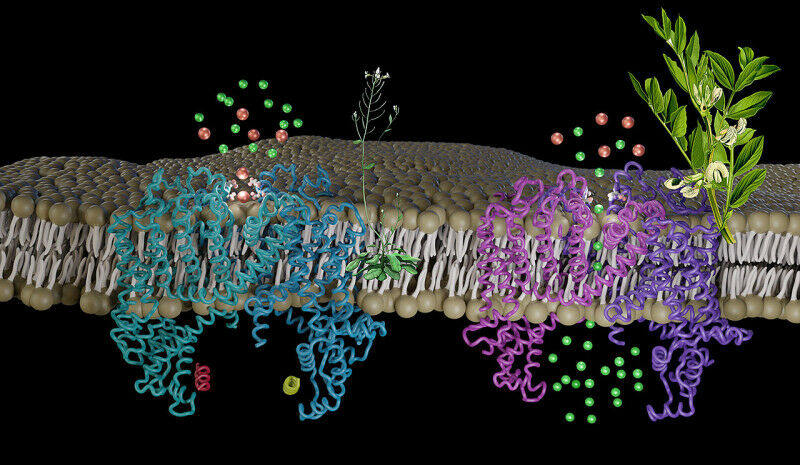
Cartoon of the 3D models of the broad bean (right, pink-violet) and the thale cress (left, blue) TPC1 ion channel protein in the vacuole membrane. On the left, Calcium ions (red spheres) in the vacuole block the entrance to the channel pore and thus the transport of potassium ions (green spheres). Due to a natural variation in the amino acid sequence, the broad bean TPC1 channel pore is not blocked. The associated hyperactivity of the bean TPC1 directly affects the electrical properties of the vacuolar membrane. (Image: Dirk Becker / Universität Würzburg)
Cartoon of the 3D models of the broad bean ( right, pink-violet ) and the thale cress (left, blue ) TPC1 ion channel protein in the vacuole membrane. On the left, Calcium ions (red spheres) in the vacuole block the entrance to the channel pore and thus the transport of potassium ions (green spheres). Due to a natural variation in the amino acid sequence, the broad bean TPC1 channel pore is not blocked. The associated hyperactivity of the bean TPC1 directly affects the electrical properties of the vacuolar membrane. (Image: Dirk Becker / Universität Würzburg) Plants in which an ion channel of the vacuole is hyperactive are extremely stressed and grow poorly. But the broad bean is an exception, as Würzburg researchers have discovered. Like the human body, plants also use electrical signals to process and pass on information.
TO READ THIS ARTICLE, CREATE YOUR ACCOUNT
And extend your reading, free of charge and with no commitment.