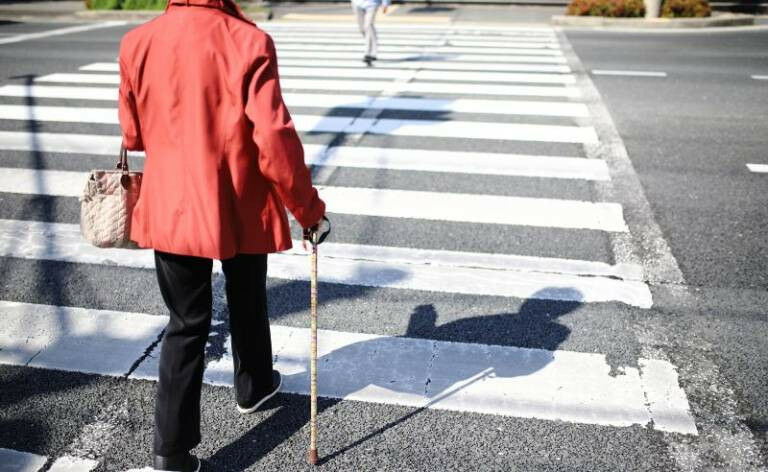
Older person crossing a road - bee32 on iStock
Older person crossing a road - bee32 on iStock People with early Alzheimer's disease have difficulty turning when walking, according to a new study using virtual reality led by UCL researchers. The study, published in Current Biology , used a computational model to further explore the intricacies of navigational errors previously observed in Alzheimer's disease. Researchers, led by Professor Neil Burgess and colleagues in the Space and Memory group* at the UCL Institute of Cognitive Neuroscience, grouped participants into three categories: healthy younger participants (31 total), healthy elderly participants (36 total) and patients with mild cognitive impairment (43 total). They then asked them to complete a task while wearing virtual reality goggles, which allowed them to make real movements. In the trial, participants walked an outbound route guided by numbered cones, consisting of two straight legs connected by a turn. They then had to return to their starting position unguided. The task was performed under three different environmental conditions aimed at stressing the participant's navigational skills; an unchanged virtual environment, the ground details being replaced by a plain texture and the temporary removal of all landmarks from the virtual reality world.
TO READ THIS ARTICLE, CREATE YOUR ACCOUNT
And extend your reading, free of charge and with no commitment.