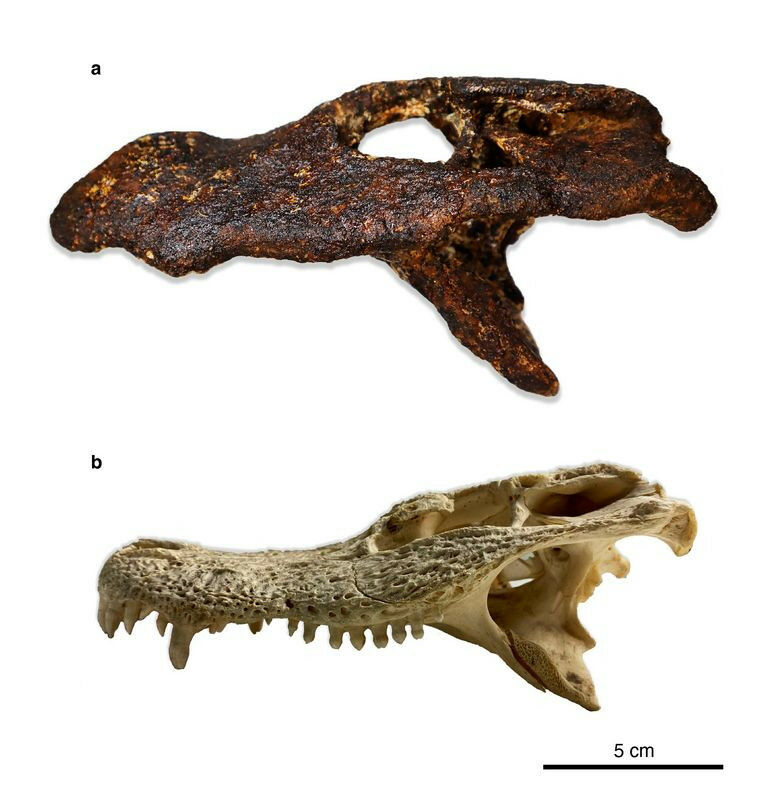
Lateral view of the skulls of (a) Alligator munensis and (b) the Chinese alligator, Alligator sinensis.
Lateral view of the skulls of (a) Alligator munensis and (b) the Chinese alligator, Alligator sinensis. University of Tübingen paleontologists Dr. Márton Rabi and Gustavo Darlim, working with Chulalongkorn University and Department of Mineral Resources of Thailand, have demonstrated that an almost completely fossilized alligator skull found in Thailand belongs to a previously unknown species. The fossil was discovered in 2005 and is at most 230,000 years old. The scientists named the newly-discovered species Alligator munensis after the Mun River, which flows near the site at Ban Si Liam where the skull was found. The research team hypothesizes that the species is an evolutionary offshoot from the Chinese alligator that still lives today. Their study has been published in the journal Scientific Reports . The Chinese alligator ( Alligator sinensis) is the only living member of the caiman and alligator family that occurs outside the Americas.
TO READ THIS ARTICLE, CREATE YOUR ACCOUNT
And extend your reading, free of charge and with no commitment.