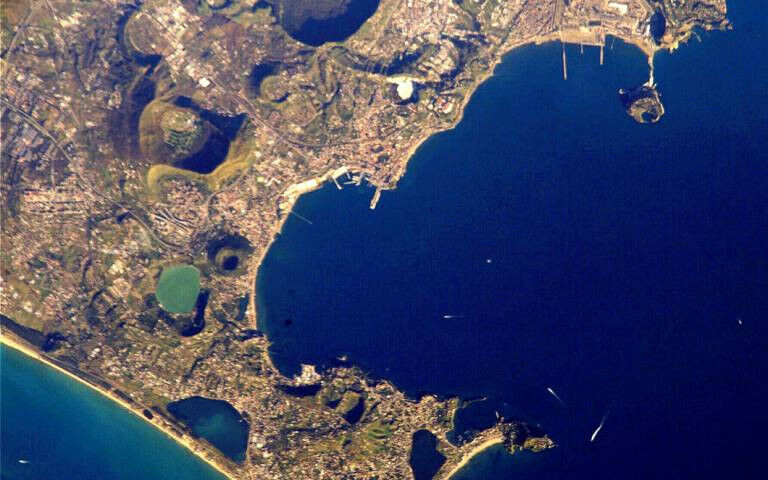
View from space of Pozzuoli and Campi Flegrei - image taken from the International Space Station
View from space of Pozzuoli and Campi Flegrei - image taken from the International Space Station The Campi Flegrei volcano in southern Italy has become weaker and more prone to rupturing, making an eruption more likely, according to a new study by researchers at UCL and Italy's National Research Institute for Geophysics and Volcanology (INGV). The volcano, which last erupted in 1538, has been restless for more than 70 years, with two-year spikes of unrest in the 1950s, 1970s and 1980s, and a slower phase of unrest over the last decade. Tens of thousands of small earthquakes have occurred during these periods and the coastal town of Pozzuoli has been lifted by nearly 4 m (13 ft), roughly the height of a double-decker bus. The new study, published in Nature's journal, used a model of volcano fracturing, developed at UCL, to interpret the patterns of earthquakes and ground uplift, and concluded that parts of the volcano had been stretched nearly to breaking point. Lead author Professor Christopher Kilburn (UCL Earth Sciences) said: "Our new study confirms that Campi Flegrei is moving closer to rupture. However, this does not mean an eruption is guaranteed. The rupture may open a crack through the crust, but the magma still needs to be pushing up at the right location for an eruption to occur.
TO READ THIS ARTICLE, CREATE YOUR ACCOUNT
And extend your reading, free of charge and with no commitment.