


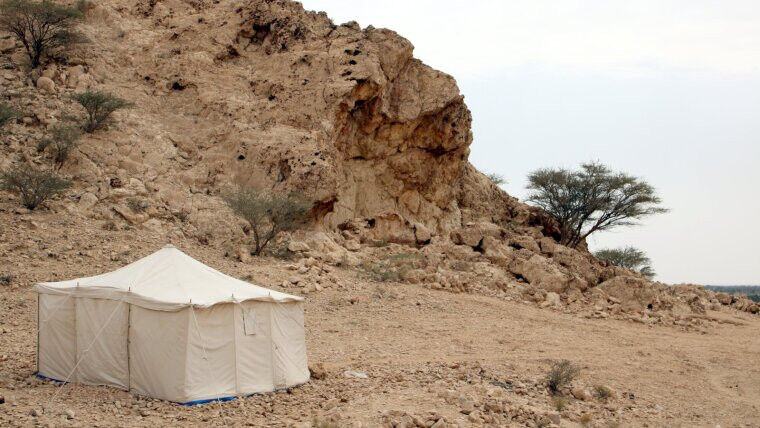
The expansion of modern humans out of Africa likely unfolded differently than previously thought: contrary to earlier assumptions, south-east Arabia was repeatedly inhabited by humans during the late Pleistocene. An international research team involving the Universities of Jena, Freiburg and Tübingen, as well as Oxford Brookes University (England), in collaboration with the Sharjah Archaeology Authority, has uncovered evidence of human settlement during excavations at the Buhais Rock Shelter in the Emirate of Sharjah (United Arab Emirates). As project leader Dr Knut Bretzke from Friedrich Schiller University in Jena explains, the finds reveal various phases of human settlement: around 125,000 years ago, 59,000, 35,000 and 16,000 years ago. The research team has now published its findings in the journal *Nature Communications*.
New findings disprove an old theory
"Until now, it was assumed that human settlement was not possible in this region during the last Ice Age," says Knut Bretzke. The region was said to have been too arid and therefore inhospitable during that period. However, the findings that have now been analysed completely overturn this theory. They suggest that the Buhais Rock Shelter was repeatedly a suitable place of residence for groups of roaming hunters and gatherers. In a sediment trap beneath the rock shelter, remains of stone tools have survived, the age of which could be determined. As Knut Bretzke explains, different sediment layers containing stone artefacts can be clearly distinguished from one another. These layers extend to a depth of 1.70 metres. They show that people returned to this region time and again over tens of thousands of years.
Southern Arabia was not consistently inhospitable during the last ice age
"Our palaeoecological data provide clear evidence of increased water availability during the periods when humans inhabited the rock shelter," says Adrian Parker of Oxford Brookes University. Field research suggests that periods of wetter conditions transformed the present-day desert into a more habitable environment in which human groups could thrive. This is evidence that South Arabia was not consistently inhospitable during the last ice age, according to Adrian Parker, this is evidence that South Arabia was not entirely inhospitable during the last ice age.
Existing models of human settlement need to be reviewed
"Our findings now provide the empirical basis for a rigorous review of existing models of human settlement in desert regions," says Dr Knut Bretzke. He adds that it is necessary to take greater account of local conditions, including the local groundwater situation and the vegetation that depends on it. Both are prerequisites for the survival of human groups. The finds from the Buhais rock shelter complement earlier discoveries from nearby Jebel Faya and extend the known evidence of an early human presence in south-eastern Arabia to the period between 210,000 and 16,000 years ago.
The area around the sites is now a World Heritage Site
The Buhais rock shelter is a natural limestone overhang that provided shelter from the sun, the weather and, to some extent, predators. The stone tools left behind there were covered by sand, and falling rocks effectively sealed the artefacts. Over the millennia, a solid layer of sediment formed, in which the stone artefacts survived as if in a time capsule. The finds are dated using a luminescence method, which determines when the respective layer was last exposed to sunlight. Due to the exceptional archaeological finds and the well-preserved palaeoecological context, the Faya Palaeolandscape, including the Buhais Rock Shelter and the Jebel Faya site, was designated a UNESCO World Heritage Site in 2025.
Original publication:
Knut Bretzke, Seolmin Kim, Sabah Jasim, Eisa Yousif, Frank Preusser, Gareth W. Preston, Francesco Pallotino and Adrian Parker: Evidence from the Buhais rock shelter for human occupation in Arabia between 60,000 and 16,000 years ago, Nature Communications, DOI: 10.1038/s41467-026-70681-z

