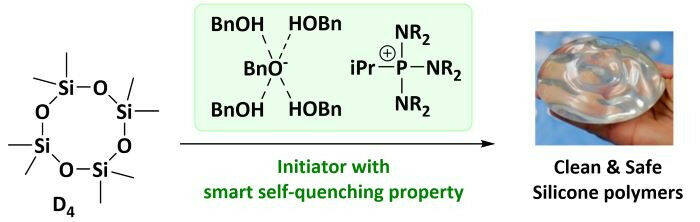
 Silicone synthesis equation developed by the research team (ECOIH/LHFA).
Silicone synthesis equation developed by the research team (ECOIH/LHFA). Tsuyoshi Kato/CNRS Polysiloxanes, the scientific name for silicones, possess exceptional properties, and are used in numerous fields ranging from cosmetics to aerospace. They are absolutely everywhere! However, small cyclic oligosiloxanes impurities - including substances classified as toxic for the environment and identified as potential endocrine disruptors - can form during their synthesis. To correct this drawback, a team of scientists 1 led by a CNRS researcher recently developed a new process for synthesising silicones from cyclic siloxanes in a cleaner and more environmentally-friendly manner by preventing the formation of these impurities in the final product. The results will appear in Science on 1 September, and could have a considerable impact on the industrial sector. Polysiloxanes, the scientific name for silicones, possess exceptional properties, and are used in numerous fields ranging from cosmetics to aerospace. They are absolutely everywhere! However, small cyclic oligosiloxanes impurities - including substances classified as toxic for the environment and identified as as potential endocrine disruptors - can form during their synthesis.
TO READ THIS ARTICLE, CREATE YOUR ACCOUNT
And extend your reading, free of charge and with no commitment.
Your Benefits
- Access to all content
- Receive newsmails for news and jobs
- Post ads