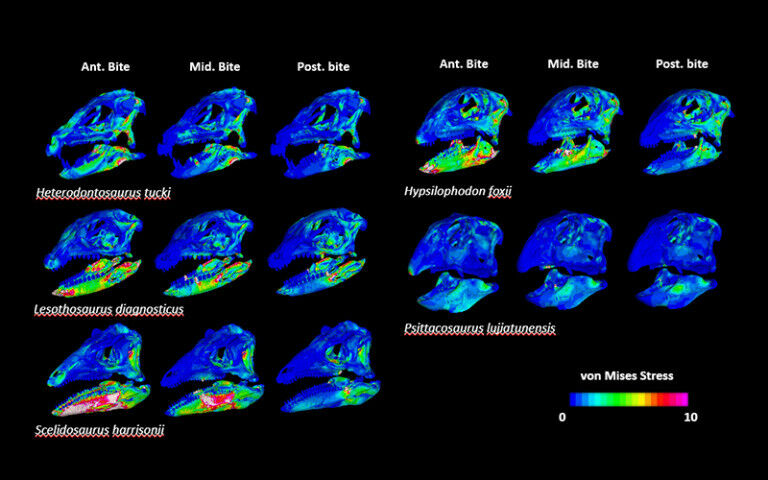
Dinosaur skulls - Some of the finite element models comparing bite performance across the five ornithischian dinosaurs in the study, with different models showing different bite points. Cooler colours (blue) represent areas of low stress while hot colours (red and pink) indicate areas that are highly stressed. Image credit: David Button
Dinosaur skulls - Some of the finite element models comparing bite performance across the five ornithischian dinosaurs in the study, with different models showing different bite points. Cooler colours ( blue ) represent areas of low stress while hot colours (red and pink) indicate areas that are highly stressed. Image credit: David Button - The skulls of early dinosaurs are helping scientists understand how some of the earliest herbivores may have evolved different ways of eating plants, reports a new study involving UCL. Most dinosaurs were plant eaters, although they are all descended from a carnivorous ancestor. Much is already known about how different dinosaurs consumed their food, but relatively little is understood about how they evolved their preferred eating styles. By reconstructing the jaw muscles and measuring the bite force of these animals, a team of researchers at UCL, the Natural History Museum and the Universities of Bristol and Birmingham have found surprising variation in eating styles amongst the first herbivorous dinosaurs, as they report in a new Current Biology paper. Senior author and palaeontologist at the Museum, Professor Paul Barrett said: "If you want to understand how dinosaurs diversified into so many different types so effectively, it's critical to learn how they evolved to feed on a such a wide variety of vegetation in so many different ways.
TO READ THIS ARTICLE, CREATE YOUR ACCOUNT
And extend your reading, free of charge and with no commitment.