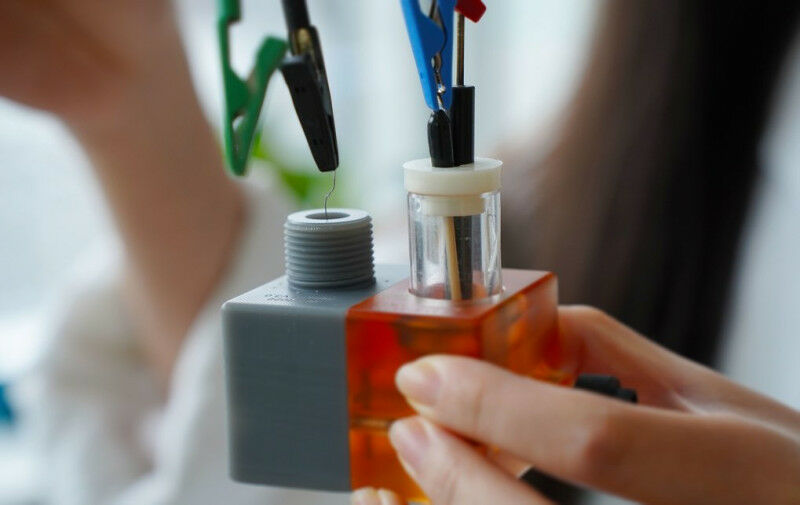
 Reaction chamber in which the artificial metabolic pathway takes place.
Using a metabolic pathway, energy-rich resources can be produced via the power of electricity. Reaction chamber in which the artificial metabolic pathway takes place. MPI for Terrestrial Microbiology/ Virginia Geisel - When nature performs chemical reactions to create energy-rich compounds from simple molecules, it requires energy. So far, it has not been possible to use human-made electricity to drive these biochemical processes. Researchers at the Max Planck Institute for Terrestrial Microbiology in Marburg have achieved a breakthrough, however: they developed an artificial metabolic pathway that uses electricity to produce ATP, a biochemical energy carrier which can then be used to form energy-rich chemical compounds like starch or protein. The metabolic pathway provides a complete novel approach towards a sustainable, climate-neutral bioeconomy. Tobias Erb's team at the Max Planck Institute in Marburg is currently exploring how synthetic biology can be used to build complex resources from simple molecules.
TO READ THIS ARTICLE, CREATE YOUR ACCOUNT
And extend your reading, free of charge and with no commitment.
Your Benefits
- Access to all content
- Receive newsmails for news and jobs
- Post ads