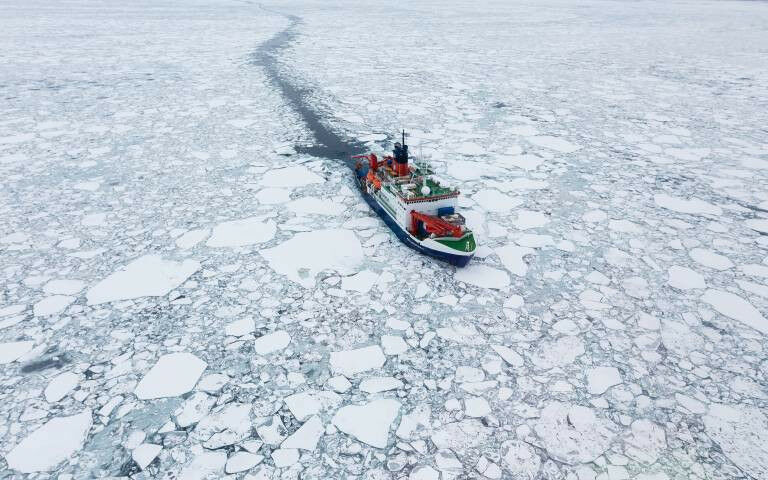
research ship Polarstern in Arctic sea ice
research ship Polarstern in Arctic sea ice Faster warming in the Arctic will be responsible for a global 2C temperature rise being reached eight years earlier than if the region was warming at the average global rate, according to a new modelling study led by UCL researchers. The Arctic is currently warming nearly four times faster than the global average rate. The new study, published in the journal Earth System Dynamics , aimed to estimate the impact of this faster warming on how quickly the global temperature thresholds of 1.5C and 2C, set down in the Paris Agreement, are likely to be breached. To do this, the research team created alternative climate change projections in which rapid Arctic warming was not occurring. They then compared temperatures in this hypothetical world with those of the "real-world" models and examined the timing with which the critical Paris Agreement thresholds of 1.5C and 2C were breached. They found that, in the models without fast Arctic warming, the thresholds were breached five and eight years later respectively, than their "real-world" projected dates of 2031 and 2051. In addition, they found that disproportionately fast Arctic warming, known as Arctic amplification, added disproportionate uncertainty to forecasts, as the variation in model projections for the region is larger than for the rest of the planet.
TO READ THIS ARTICLE, CREATE YOUR ACCOUNT
And extend your reading, free of charge and with no commitment.