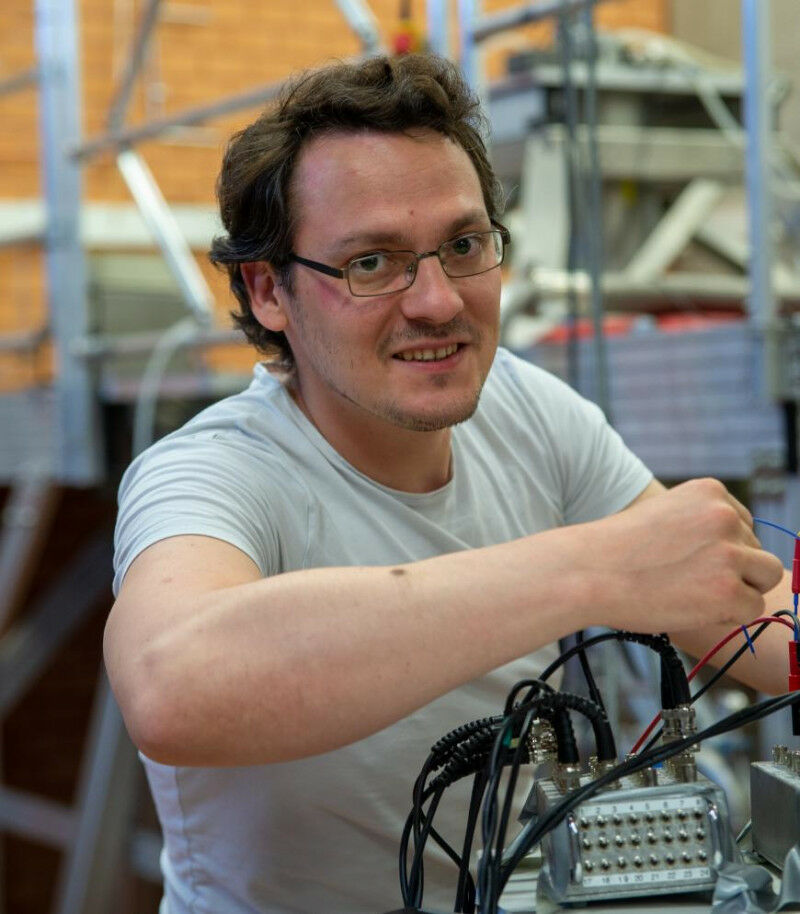
Oleksandr Zheliuk
Oleksandr Zheliuk In a ground-breaking experiment, scientists from the University of Groningen, together with colleagues from HFML-FELIX, University of Twente and the Harbin Institute of Technology (China), have discovered the existence of a superconductive state that was first predicted in 2017. In this week's edition of Nature, they present evidence for a special variant of the so-called FFLO superconducting state, a discovery that could have significant applications, particularly in the field of superconducting electronics. The leader of the collaboration is Professor Justin Ye from Groningen. Ye and his team have been working on the Ising superconducting state, a state they discovered at HFML-FELIX in 2015. This is a special state that can resist magnetic fields that generally destroy superconductivity. In 2019, they created a device comprising a double layer of molybdenum disulfide that could couple the Ising superconductivity states residing in the two layers. Interestingly, the device makes it possible to switch this protection on or off using an electric field, resulting in a superconducting transistor.
TO READ THIS ARTICLE, CREATE YOUR ACCOUNT
And extend your reading, free of charge and with no commitment.