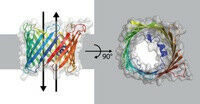
Model of the beta-barrel protein porin from baker’s yeast found in the mitochondrial outer membrane. Illustration: Christophe Wirth
Model of the beta-barrel protein porin from baker's yeast found in the mitochondrial outer membrane. Illustration: Christophe Wirth - Study by a team of researchers from Freiburg and Kyoto investigates formation of beta-barrel membrane proteins that make up the pores Mitochondria are considered to be the power plants of cells and are essential for human metabolism. Dysfunction in 40 percent of mitochondrial proteins are associated with human diseases, which is why mitochondria also play an important role in medical research. A previously unexplained process in the complex mitochondria was the formation of their barrel pores. These are located within the mitochondrial outer membrane and serve as a portal through which substances are exchanged between mitochondria and the cell water. Researchers at the University of Freiburg and the University of Kyoto/Japan have now been able to elucidate the guidance mechanism by which the pores are formed through structural and functional experiments. The study by the team led by Nils Wiedemann and Nikolaus Pfanner from the Faculty of Medicine and the Cluster of Excellence CIBSS at the University of Freiburg and by Toshiya from Kyoto Sangyo University has been published in the journal Nature Structural & Molecular Biology.
TO READ THIS ARTICLE, CREATE YOUR ACCOUNT
And extend your reading, free of charge and with no commitment.