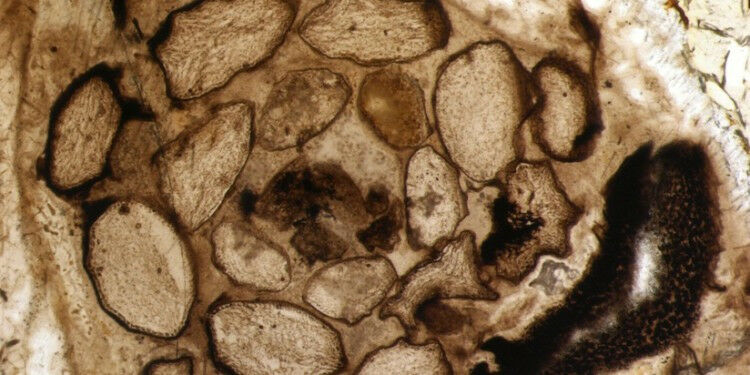
 Cross-section of a shoot tip of Asteroxylon mackiei, a very early lycopod from the Lower Devonian (ca. 309 million years ago) of Rhynie (Aberdeenshire, Scotland)
A 3D model of a 407-million-year-old plant fossil has overturned thinking on the evolution of leaves / "Science" publication. Cross-section of a shoot tip of Asteroxylon mackiei, a very early lycopod from the Lower Devonian (ca. 309 million years ago) of Rhynie (Aberdeenshire, Scotland) © WWU - Kerp A 3D model of a 407-million-year-old plant fossil has overturned thinking on the evolution of leaves. The research has also led to fresh insights about spectacular patterns found in plants. Hans Kerp from the Institute of Geology and Palaeontology at the University of Münster was involved in this international study. The research is published in the journal Science. Leaf arrangements in the earliest plants differ from most modern plants, overturning a long-held theory regarding the origins of a famous mathematical pattern found in nature, research shows. The findings indicate that the arrangement of leaves into distinctive spirals, that are common in nature today, were not common in the most ancient land plants that first populated the earth's surface.
TO READ THIS ARTICLE, CREATE YOUR ACCOUNT
And extend your reading, free of charge and with no commitment.
Your Benefits
- Access to all content
- Receive newsmails for news and jobs
- Post ads