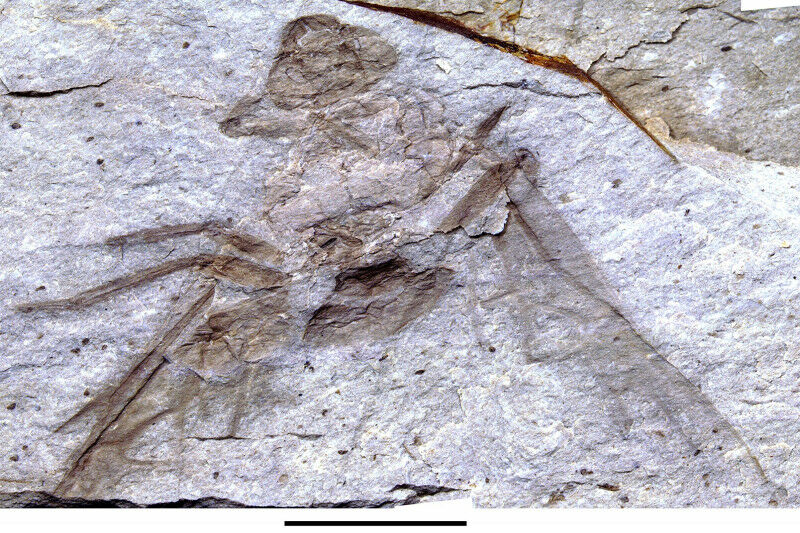
The giant fossil queen ant Titanomyrma, recently discovered in the Allenby Formation near Princeton, British Columbia, the first of its kind in Canada. Photo Credit: Bruce Archibald
The giant fossil queen ant Titanomyrma, recently discovered in the Allenby Formation near Princeton, British Columbia, the first of its kind in Canada. Photo Credit: Bruce Archibald Simon Fraser scientists say their research on the latest fossil find near Princeton, B.C. is raising questions about how the dispersal of animals and plants occurred across the Northern Hemisphere some 50 million years ago, including whether brief intervals of global warming were at play. The fossil was discovered by Princeton resident Beverly Burlingame and made available to the researchers through the town's museum. Researchers say it is the first Canadian specimen of the extinct ant Titanomyrma , whose biggest species was surprisingly gigantic, with the body mass of a wren and a wingspan of half a foot. SFU paleontologists Bruce Archibald and Rolf Mathewes, together with Arvid Aase of Fossil Butte National Monument in Wyoming, have published their research on the fossil in the current edition of the scientific journal The Canadian Entomologist . A decade earlier, Archibald and collaborators discovered a gigantic Titanomyrma fossil from Wyoming in a museum drawer in Denver. -This ant and the new fossil from British Columbia are close in age to other Titanomyrma fossils that have been long known in Germany and England,- says Archibald. -This raises the questions of how these ancient insects traveled between continents to appear on both sides of the Atlantic at nearly the same time. Europe and North America were connected by land across the Arctic then, as the North Atlantic had not yet opened enough by continental drift to fully separate them. But was the ancient far-northern climate suitable for their passage?
TO READ THIS ARTICLE, CREATE YOUR ACCOUNT
And extend your reading, free of charge and with no commitment.