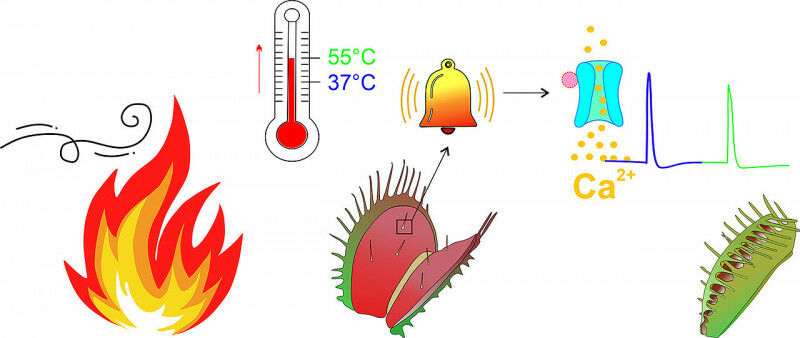
The Venus flytrap has a heat sensor in its sensory hairs, through which it reacts to heat waves in the run-up to bushfires. If the temperature rapidly exceeds the 37 degree Celsius mark, a calcium-dependent action potential (AP) is fired as a warning signal. If the temperature rises to the threshold of 55 degrees Celsius, a second AP is fired, the trap closes and the sensory hairs are protected from burning. (Image: Shouguang Huang / Universität Würzburg)
The Venus flytrap has a heat sensor in its sensory hairs, through which it reacts to heat waves in the run-up to bushfires. If the temperature rapidly exceeds the 37 degree Celsius mark, a calcium-dependent action potential (AP) is fired as a warning signal. If the temperature rises to the threshold of 55 degrees Celsius, a second AP is fired, the trap closes and the sensory hairs are protected from burning. (Image: Shouguang Huang / Universität Würzburg) The sensory hairs of the Venus flytrap contain a heat sensor that warns the plant of bush fires. It reacts to rapid temperature jumps, as Würzburg researchers have discovered. The Venus flytrap can survive in the nutrient-poor swamps of North and South Carolina because it compensates for the lack of nitrogen, phosphate and minerals by catching and eating small animals. It hunts with snap traps that have sensory hairs on them.
TO READ THIS ARTICLE, CREATE YOUR ACCOUNT
And extend your reading, free of charge and with no commitment.