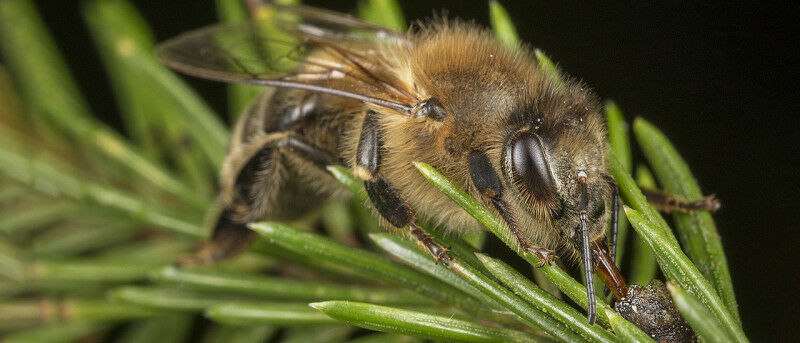
A honeybee (Apis mellifera) collects honeydew on a fir tree. The study shows that the beech-dominated Steigerwald provides insufficient food resources for honeybees. (Image: Ingo Arndt)
A honeybee (Apis mellifera) collects honeydew on a fir tree. The study shows that the beech-dominated Steigerwald provides insufficient food resources for honeybees. (Image: Ingo Arndt) What role do forests play as a feeding habitat for honeybees? A team led by Würzburg biologist Dr. Benjamin Rutschmann investigated this question. For this purpose, the researchers used observation hives inside the Steigerwald. Bees are generally associated with flowering meadows rather than with dense forests. Woodland, however, is considered the original habitat of the western honeybee ( Apis mellifera ), as it offers nesting sites in the form of tree cavities. Researchers Rutschmann at the Julius-Maximilians-Universität Würzburg (JMU) have now investigated the extent to which contemporary deciduous forests are suitable as foraging habitats for the busy insects.
TO READ THIS ARTICLE, CREATE YOUR ACCOUNT
And extend your reading, free of charge and with no commitment.