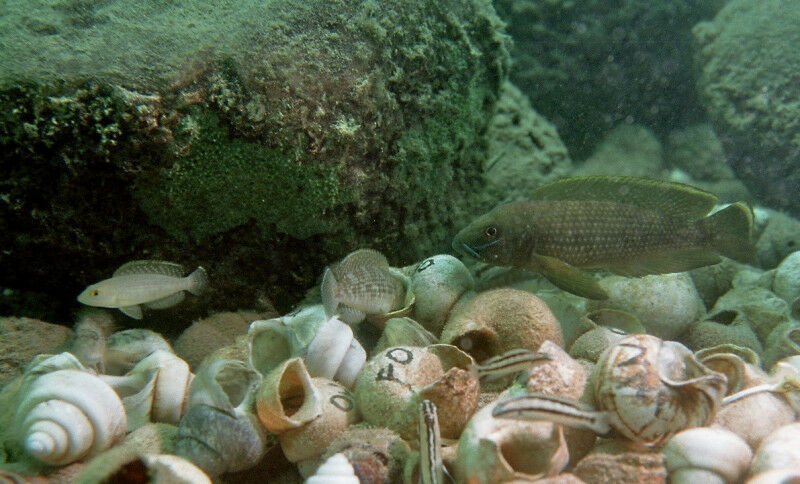
 A nest of empty snail shells with the giant territorial nest owner (right), a female just entering a shell (middle) and a parasitic dwarf male (left). The striped fish in the foreground are egg predators.
A nest of empty snail shells with the giant territorial nest owner ( right ), a female just entering a shell ( middle ) and a parasitic dwarf male ( left ). The striped fish in the foreground are egg predators. Sabine Wirtz-Ocana - In certain Lake Tanganyika cichlids breeding in empty snail shells, there are two extreme sizes of males: giants and dwarfs. Researchers from the University of Bern and the University of Graz have analysed the genomes of these fish and found out how the peculiar sizes of males and females evolved in conjunction with the genetic sex determination mechanism. A giant nest owner on top of a shell while releasing sperm to fertilise eggs that are deposited inside. A glance behind closed curtains (sketch) reveals that apart from the female, there is also a dwarf male trying to fertilise the eggs from inside the shell. Michael & Barbara Taborsky - Difference in body size (or sexual dimorphism) between males and females is common across the animal kingdom.
TO READ THIS ARTICLE, CREATE YOUR ACCOUNT
And extend your reading, free of charge and with no commitment.
Your Benefits
- Access to all content
- Receive newsmails for news and jobs
- Post ads