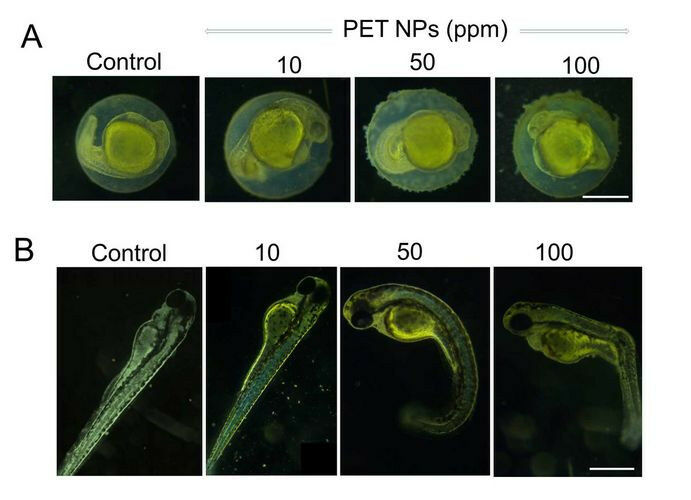
Images showing the effect of PET nanoparticles (PET NPs) at 24 hours (A) and 72 hours (B) on early stages of zebrafish embryo development. Photo: Bashirova et al. Scientific Reports 13: 1891 (2023)
Images showing the effect of PET nanoparticles (PET NPs) at 24 hours (A) and 72 hours (B) on early stages of zebrafish embryo development. Photo: Bashirova et al. Scientific Reports 13: 1891 (2023) PET, the plastic used to make bottles, for example, is ubiquitous in our natural environment. In a joint study, scientists from Leipzig University and the Helmholtz Centre for Environmental Research (UFZ) investigated the negative effects that tiny plastic PET particles can have on the metabolism and development of an organism. Their findings have now been published in the journal -Scientific Reports-. The increasing use of plastic is threatening ecosystems around the world. One of the big concerns is the presence of plastics in the form of small particles, also called microplastics and nanoplastics.
TO READ THIS ARTICLE, CREATE YOUR ACCOUNT
And extend your reading, free of charge and with no commitment.