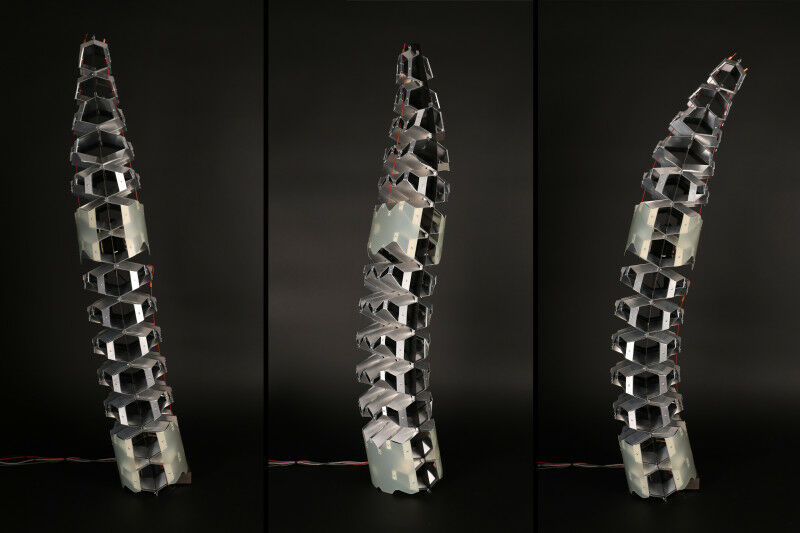
MIT researchers used kirigami, the art of Japanese paper cutting and folding, to develop ultrastrong, lightweight materials that have tunable mechanical properties, like stiffness and flexibility. These materials could be used in airplanes, automobiles, or spacecraft. Credits : Image: Courtesy of the researchers
MIT researchers used kirigami, the art of Japanese paper cutting and folding, to develop ultrastrong, lightweight materials that have tunable mechanical properties, like stiffness and flexibility. These materials could be used in airplanes, automobiles, or spacecraft. Credits : Image: Courtesy of the researchers Produced with techniques borrowed from Japanese paper-cutting, the strong metal lattices are lighter than cork and have customizable mechanical properties. Cellular solids are materials composed of many cells that have been packed together, such as a honeycomb. The shape of those cells largely determines the material's mechanical properties, including its stiffness or strength. Bones, for instance, are filled with a natural material that enables them to be lightweight, but stiff and strong. Inspired by bones and other cellular solids found in nature, humans have used the same concept to develop architected materials.
TO READ THIS ARTICLE, CREATE YOUR ACCOUNT
And extend your reading, free of charge and with no commitment.