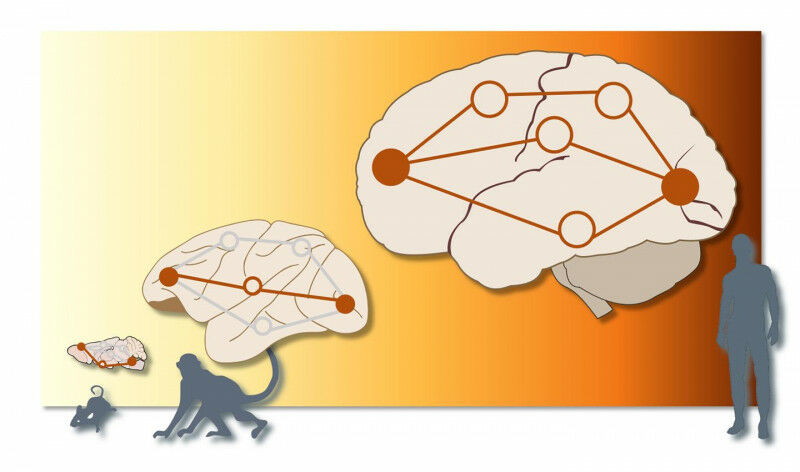
 In the mouse and macaque brains, information was sent along a single ’road’, while in humans, there were multiple parallel pathways between the same source and target.
In the mouse and macaque brains, information was sent along a single 'road', while in humans, there were multiple parallel pathways between the same source and target. Alessandra Griffa CHUV/EPFL CC BY-SA In a study comparing human brain communication networks with those of macaques and mice, researchers found that only the human brains transmitted information via multiple parallel pathways, yielding new insights into mammalian evolution. When describing brain communication networks, EPFL senior postdoctoral researcher Alessandra Griffa likes to use travel metaphors. Brain signals are sent from a source to a target, establishing a polysynaptic pathway that intersects multiple brain regions "like a road with many stops along the way." She explains that structural brain connectivity pathways have already been observed based on networks ("roads") of neuronal fibers. But as a scientist in the Medical Image Processing Lab ( MIP:Lab ) in EPFL's School of Engineering, and a research coordinator at CHUV's Leenaards Memory Centre , Griffa wanted to follow patterns of information transmission to see how messages are sent and received. In a study recently published in Nature Communications , she worked with MIP:Lab head Dimitri Van De Ville and SNSF Ambizione Fellow Enrico Amico to create "brain traffic maps" that could be compared between humans and other mammals. To achieve this, the researchers used open-source diffusion (DWI) and functional magnetic resonance imaging (fMRI) data from humans, macaques, and mice, which was gathered while subjects were awake and at rest.
TO READ THIS ARTICLE, CREATE YOUR ACCOUNT
And extend your reading, free of charge and with no commitment.
Your Benefits
- Access to all content
- Receive newsmails for news and jobs
- Post ads


