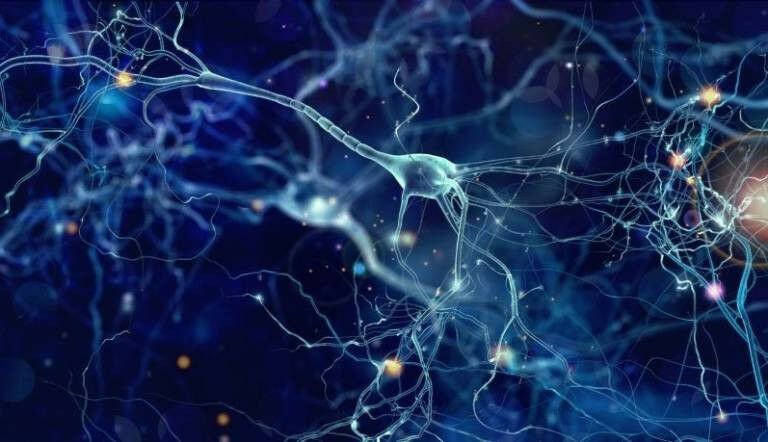
Conceptual illustration of neuron cells with glowing link knots in abstract dark space, high resolution 3D illustration
Conceptual illustration of neuron cells with glowing link knots in abstract dark space, high resolution 3D illustration A team of researchers led by Professor Bart De Strooper (UK Dementia Research Institute at UCL, and VIB-KU Leuven) and Dr Sriram Balusu (VIB-KU Leuven) have discovered how neurons die in Alzheimer's disease. The breakthrough study, published in Science , illustrates how neurons initiate a programmed form of cell death, known as necroptosis, when they are exposed to amyloid plaques and tau tangles - the hallmark misfolded proteins implicated in Alzheimer's disease. Crucially, the research team were also able to prevent the death of neurons and rescue them in the process. This discovery opens new pathways for potential future treatments. Alzheimer's disease is one of the most common forms of dementia, accounting for 60% to 70% of dementia diagnoses. Each year, between six and seven million patients are diagnosed with Alzheimer's. As a debilitating disease that often comes with major emotional and psychological burden for patients and their families, it represents a growing societal challenge and has been classified as a public health priority by the World Health Organisation (WHO).
TO READ THIS ARTICLE, CREATE YOUR ACCOUNT
And extend your reading, free of charge and with no commitment.