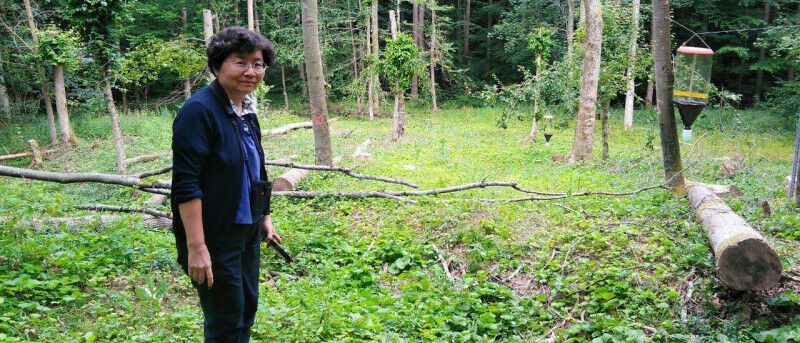
The mastermind behind the new statistical method: mathematician and statistician Anne Chao from National Tsing Hua University in Taiwan. Here she is in the university forest of the University of Würzburg on an experimental test plot. (Image: Simon Thorn/JMU)
The mastermind behind the new statistical method: mathematician and statistician Anne Chao from National Tsing Hua University in Taiwan. Here she is in the university forest of the University of Würzburg on an experimental test plot. (Image: Simon Thorn/JMU) - A DFG research group led by the University of Würzburg has developed a method that makes it possible to analyse the relationship between biodiversity within and between ecosystems and the multifunctionality of entire landscapes. Ecosystems fulfil a number of vital tasks: They store carbon, clean polluted water, pollinate plants and so on. How well an ecosystem can fulfil these tasks depends largely on its biodiversity, i.e. the variety of plants, animals and microorganisms that live in it. Until now, scientists have only been able to understand the exact nature of this relationship at a local level, for example in relation to individual forest areas, meadows and ponds. The DFG research group BETA-FOR, led by the University of Würzburg (JMU), has now succeeded in developing a statistical method that for the first time can also analyse the contributions of biodiversity between local ecosystems to the multifunctionality of entire landscapes.
TO READ THIS ARTICLE, CREATE YOUR ACCOUNT
And extend your reading, free of charge and with no commitment.