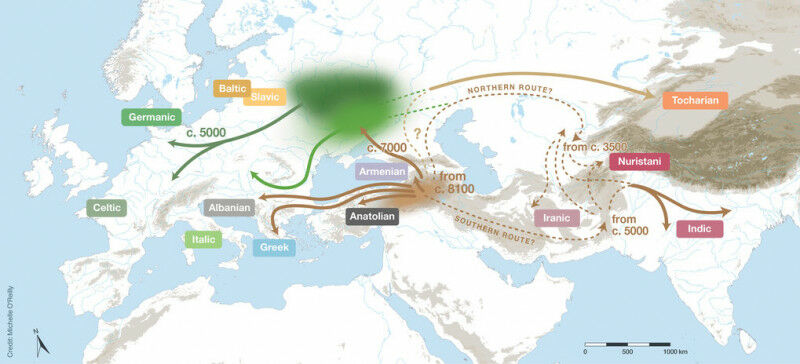
 A hybrid hypothesis for the origin and spread of the Indo-European languages. The language family began to diverge from around 8100 years ago, out of a homeland immediately south of the Caucasus. One migration reached the Pontic-Caspian and Forest Steppe around 7000 years ago, and from there subsequent migrations spread into parts of Europe around 5000 years ago.
Linguistics and genetics combine to suggest a new hybrid hypothesis for the origin of the Indo-European languages. A hybrid hypothesis for the origin and spread of the Indo-European languages. The language family began to diverge from around 8100 years ago, out of a homeland immediately south of the Caucasus. One migration reached the Pontic-Caspian and Forest Steppe around 7000 years ago, and from there subsequent migrations spread into parts of Europe around 5000 years ago. P. Heggarty et al. Science (2023) - An international team of linguists and geneticists led by researchers from the Max Planck Institute for Evolutionary Anthropology in Leipzig has achieved a significant breakthrough in our understanding of the origins of Indo-European, a family of languages spoken by nearly half of the world's population. For over two hundred years, the origin of the Indo-European languages has been disputed.
TO READ THIS ARTICLE, CREATE YOUR ACCOUNT
And extend your reading, free of charge and with no commitment.
Your Benefits
- Access to all content
- Receive newsmails for news and jobs
- Post ads


