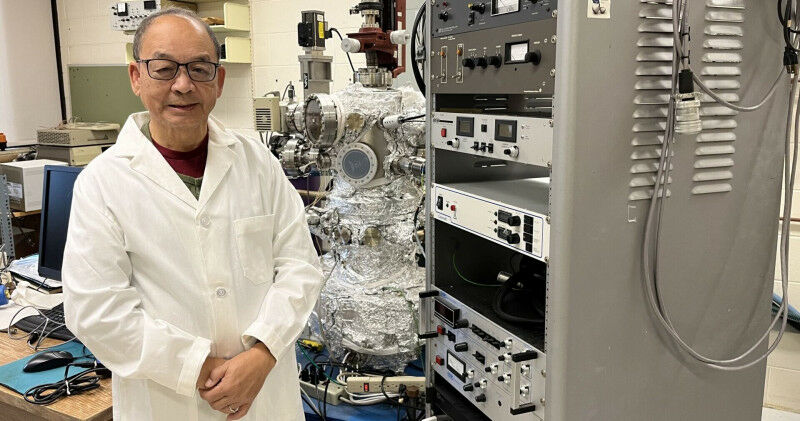
T.K. Sham, Canada Research Chair in Materials and Synchrotron Radiation, in his lab with a surface science chamber equipped with x-ray, electron gun and optical spectrometer. (Photo by Jeff Renaud)
T.K. Sham, Canada Research Chair in Materials and Synchrotron Radiation, in his lab with a surface science chamber equipped with x-ray, electron gun and optical spectrometer. (Photo by Jeff Renaud) There is an urgent need to address climate change, making the development of sustainable energy alternatives more important than ever. While proton-exchange membrane fuel cells (PEMFCs) have shown great promise for energy production, particularly in the transportation industry, there is a long-standing problem with their durability and cost. A Western research team has addressed the issue with a new cobalt-modified nanomaterial making PEMFCs more robust, readily sourced and environmentally sustainable demonstrating just a two per cent loss in efficiency rate following 20,000 cycles in a durability test. The new nanomaterial is used to enhance oxygen reduction reaction (ORR), the process that forms water in the fuel cell allowing a higher current for more efficient power generation. The cobalt-modified nanomaterial also reduces the reliance on platinum to construct these fuel cells. A costly precious metal, and mined primarily in South Africa, only a few hundred tonnes of platinum are produced annually.
TO READ THIS ARTICLE, CREATE YOUR ACCOUNT
And extend your reading, free of charge and with no commitment.