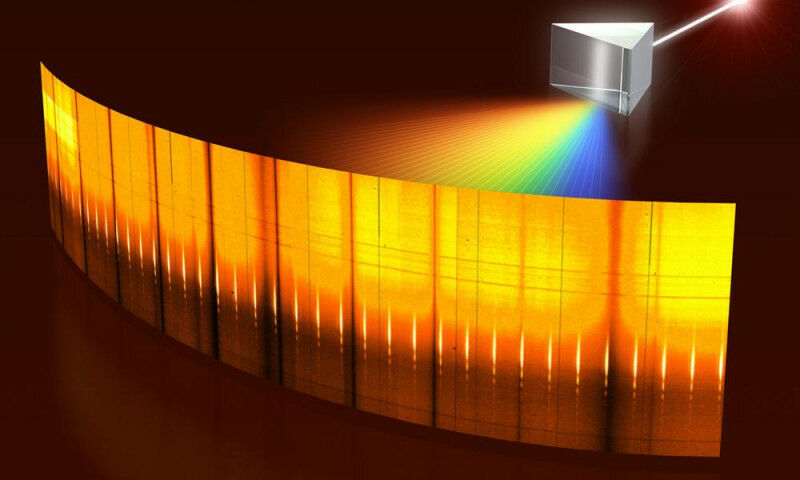
The Universidad Carlos III de Madrid (UC3M) has patented a new system for capturing hyperspectral images (those capable of collecting information across the entire electromagnetic spectrum), which can operate in real time and provides a higher resolution than any other existing technology. This development could mean a breakthrough for scientific and industrial applications related to chemical analysis. This system, patented by UC3M's Sensors and Instrumentation Techniques group, is made up of a light source that transforms a normal camera into what is known as a hyperspectral camera. This technology makes it possible to obtain complete characterisations of the chemical composition of the sample being analysed, by measuring the optical absorptions or molecular resonances that are characteristic of each compound. To do this, an advanced analytical technique known as dual-comb spectroscopy is used. Dual-comb systems work by interfering light from two optical sources, called optical frequency combs. This mixing process generates a signal, called an interferogram, at a speed that, until very recently, was too fast to be captured even by very high-speed cameras.
TO READ THIS ARTICLE, CREATE YOUR ACCOUNT
And extend your reading, free of charge and with no commitment.