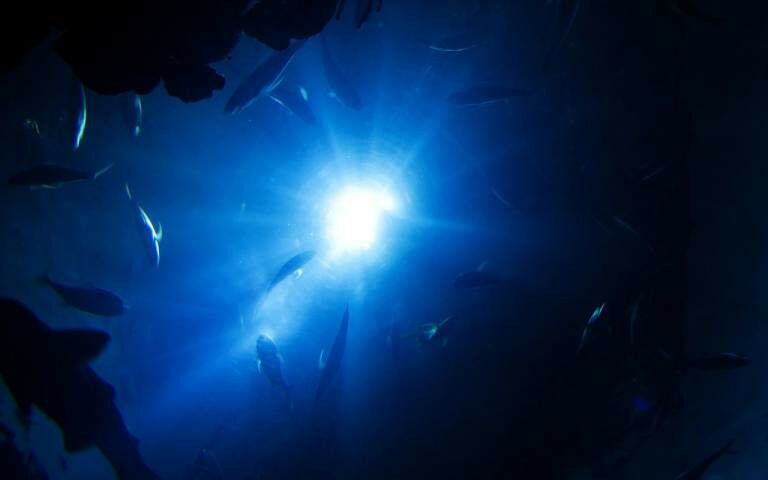
stock underwater image with fish
stock underwater image with fish - Life in the ocean's "twilight zone" could decline dramatically due to climate change, suggests a new study involving UCL researchers. The twilight zone (200m to 1,000m deep) gets very little light but is home to a wide variety of organisms and billions of tonnes of organic matter. The new study, published in the journal Nature Communications , warns that climate change could cause a 20-40% reduction in twilight zone life by the end of the century. And in a high-emissions future, life in the twilight zone could be severely depleted within 150 years, with no recovery for thousands of years. The research team, made up of palaeontologists and ocean modellers, looked at how abundant life was in the twilight zone in past warm climates, using records from preserved microscopic shells in ocean sediments. Co-author Professor Bridget Wade (UCL Earth Sciences) said: " We used microscopic fossils, which are roughly the size of a grain of sand, to reconstruct food supply to the twilight zone in the Earth's past. "Our study showed that in past warm oceans less organic matter (food) reached the twilight zone.
TO READ THIS ARTICLE, CREATE YOUR ACCOUNT
And extend your reading, free of charge and with no commitment.