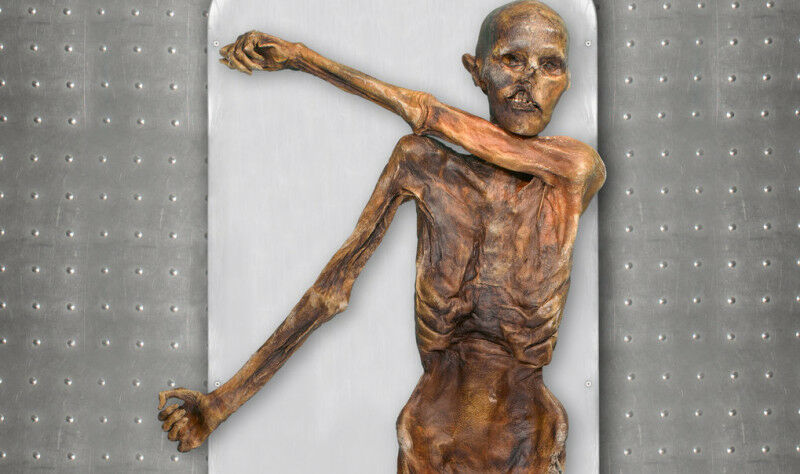
 Since 2012, which is when Ötzi’s genome was sequenced for the first time, DNA sequencing technologies have advanced enormously. This new study reveals that compared to other contemporary Europeans, Ötzi’s genome had an unusually high proportion of genes in common with those of early farmers from Anatolia, that his skin was darker than previously thought, and that he was likely bald or had little hair on his head when he died.
Research team used advanced sequencing technology to analyze Ötzi's genome to obtain a more accurate picture of the Iceman's appearance and genetic origins. Since 2012, which is when Ötzi's genome was sequenced for the first time, DNA sequencing technologies have advanced enormously. This new study reveals that compared to other contemporary Europeans, Ötzi's genome had an unusually high proportion of genes in common with those of early farmers from Anatolia, that his skin was darker than previously thought, and that he was likely bald or had little hair on his head when he died. South Tyrol Museum of Archaeology/Eurac/Marco Samadelli-Gregor Staschitz - Ötzi's genome was decoded for the first time more than ten years ago. This was also the first time the genome of a mummy had been sequenced. The results provided important insights into the genetic makeup of prehistoric Europeans. Advances in sequencing technology have now enabled a research team from the Max Planck Institute for Evolutionary Anthropology and Eurac Research to reconstruct Ötzi's genome more accurately.
TO READ THIS ARTICLE, CREATE YOUR ACCOUNT
And extend your reading, free of charge and with no commitment.
Your Benefits
- Access to all content
- Receive newsmails for news and jobs
- Post ads