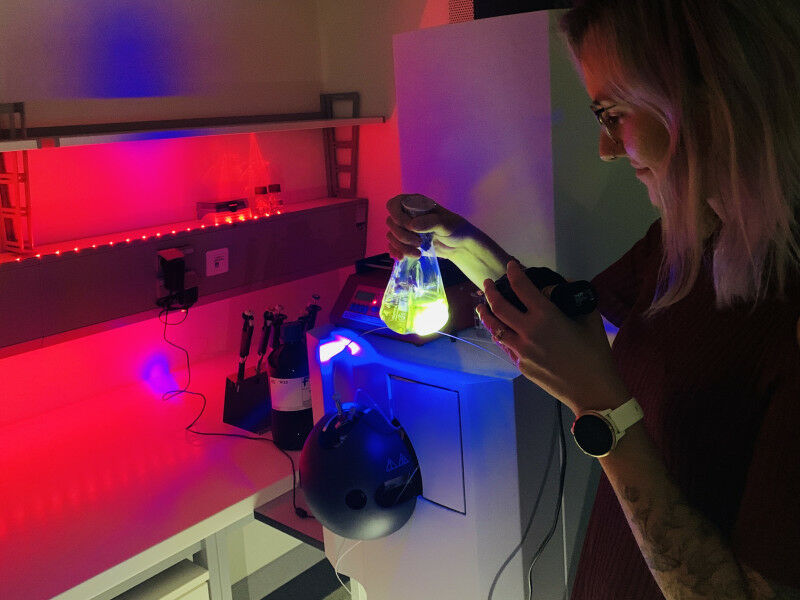
Ursula Vide from the Institute of Biochemistry at TU Graz in the laboratory. Image source: TU Graz
Researchers at TU Graz have gained new insights into the functioning of a protein found in bacteria, whose enzymatic activity is activated by blue light. Ursula Vide from the Institute of Biochemistry at TU Graz in the laboratory. Image source: TU Graz - Light affects living organisms in many different ways: for example, plants orient their growth direction towards the sun, while circadian rhythms in humans are controlled by daylight. These processes always involve photoreceptors, which are proteins that can sense different colours and intensities of light. 10,000-fold increase in enzymatic activity. Now, researchers at Graz University of Technology (TU Graz) have deciphered the function of a highly efficient photoreceptor. Their findings have been published in the journal Science Advances.
TO READ THIS ARTICLE, CREATE YOUR ACCOUNT
And extend your reading, free of charge and with no commitment.