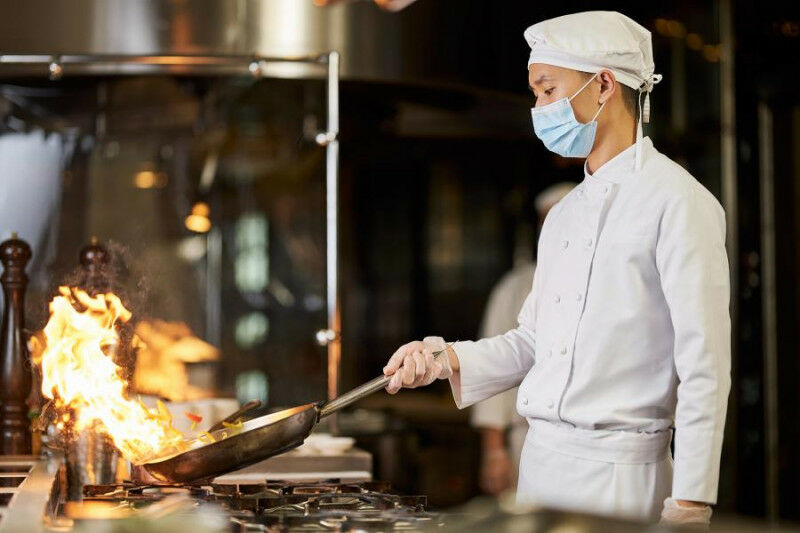
A male Asian chef wearing a surgical mask makes stir fry in a commercial kitchen
A male Asian chef wearing a surgical mask makes stir fry in a commercial kitchen Researchers serve up an improved model of indoor pollution produced by cooking S tir-frying yields more than just tasty dishes like Kung Pao chicken and Hunan beef. It also emits an invisible mixture of gases and particles that pollute indoor air and can be detrimental to human health. Correctly estimating such cooking emissions in a variety of settings is critical for simulating exposure and informing health guidelines aimed at keeping people safe. A team of researchers that included a Johns Hopkins University air-quality expert has developed a new model that can more accurately estimate and predict the concentration of particulate matter produced during stir-frying. Their approach improves on traditional methods, which have limitations when applied to real-world settings such as private homes and restaurants. "This new method utilized detailed particulate measurement data to develop a model that incorporates the dynamic changes in concentration and composition of particles as emissions from cooking move from where cooking happens to other areas of our indoor spaces. With this improved model, we can better understand the potential of exposure to cooking emissions in homes or commercial cooking areas," said Peter DeCarlo , an associate professor of environmental health and engineering at Johns Hopkins.
TO READ THIS ARTICLE, CREATE YOUR ACCOUNT
And extend your reading, free of charge and with no commitment.