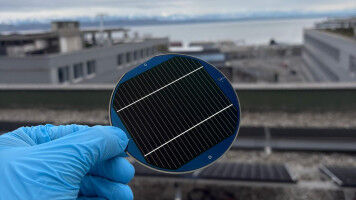
The monolithically integrated photo battery made of organic materials achieves a discharge potential of 3.6 volts. Picture: Robin Wessling
The monolithically integrated photo battery made of organic materials achieves a discharge potential of 3.6 volts. Picture: Robin Wessling Researchers from the Universities of Freiburg and Ulm have developed a monolithically integrated photo battery using organic materials. Networked intelligent devices and sensors can improve the energy efficiency of consumer products and buildings by monitoring their consumption in real time. Miniature devices like these being developed under the concept of the Internet of Things require energy sources that are as compact as possible in order to function autonomously. Monolithically integrated batteries that simultaneously generate, convert, and store energy in a single system could be used for this purpose. A team of scientists at the University of Freiburg's Cluster of Excellence Living, Adaptive, and Energy-Autonomous Materials Systems ( MatS) has developed a monolithically integrated photo battery consisting of an organic polymer-based battery and a multi-junction organic solar cell. The battery, presented by Rodrigo Delgado Andrés and Dr. Uli Würfel, University Freiburg, and Robin Wessling and Birgit Esser , University of Ulm, is the first monolithically integrated photo battery made of organic materials to achieve a discharge potential of 3.6 volts.
TO READ THIS ARTICLE, CREATE YOUR ACCOUNT
And extend your reading, free of charge and with no commitment.