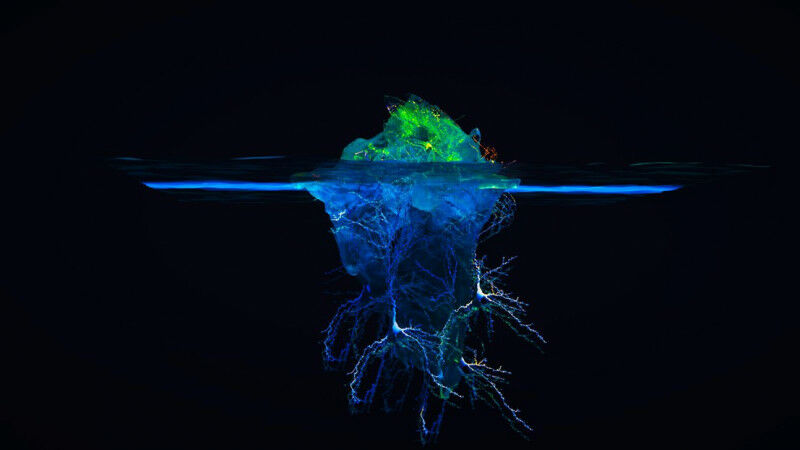
 © 2023 EPFL / Ella Marushchenko. The brain's neural activity is largely hidden in complex, nonlinear systems, much like how we can only see the surface of icebergs.
© 2023 EPFL / Ella Marushchenko. The brain's neural activity is largely hidden in complex, nonlinear systems, much like how we can only see the surface of icebergs. A research team from EPFL has developed a novel machine-learning algorithm that can reveal the hidden structure in data recorded from the brain, predicting complex information such as what mice see. Is it possible to reconstruct what someone sees based on brain signals alone? The answer is no, not yet. But researchers have made a step in that direction by introducing a new algorithm for building artificial neural network models that capture brain dynamics with an impressive degree of accuracy. Rooted in mathematics, the novel machine learning algorithm is called CEBRA (pronounced zebra), and learns the hidden structure in the neural code. What information the CEBRA learns from the raw neural data can be tested after training by decoding - a method that is used for brain-machine-interfaces (BMIs) - and they've shown they can decode from the model what a mouse sees while it watches a movie.
TO READ THIS ARTICLE, CREATE YOUR ACCOUNT
And extend your reading, free of charge and with no commitment.
Your Benefits
- Access to all content
- Receive newsmails for news and jobs
- Post ads