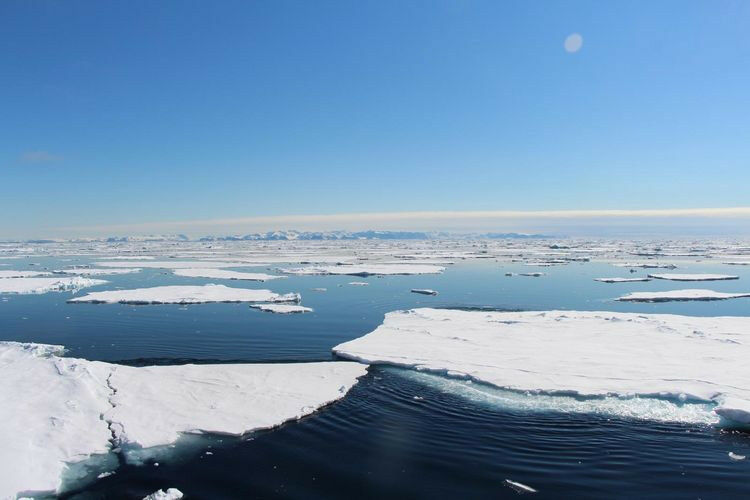
Arctic expedition to Greenland and Spitsbergen in spring/summer 2017 with the icebreaker Polarstern and two research aircraft as part of the CRC. Photo: University of Leipzig
Arctic expedition to Greenland and Spitsbergen in spring/summer 2017 with the icebreaker Polarstern and two research aircraft as part of the CRC. Photo: University of Leipzig - News from The Collaborative Research Centre "Arctic Amplification: Climate Relevant Atmospheric and Surface Processes and Feedback Mechanism (AC)³", which is headed by meteorologist Professor Manfred Wendisch from Leipzig University, is to enter its third funding phase. This was announced today (24 November 2023) by the German Research Foundation (DFG). From January 2024, the research network, which also includes the Universities of Bremen and Cologne, the Alfred Wegener Institute, Helmholtz Centre for Polar and Marine Research (AWI) and the Leibniz Institute for Tropospheric Research (TROPOS), will continue its ground-breaking work for another four years. The overall aim is to make fundamental and significant advances in our understanding of Arctic amplification and improve the reliability of models used to predict the dramatic warming of the Arctic. "Over the past 25 years, we have observed a drastic increase in near-surface air temperatures in the Arctic, which is two to three times more pronounced than global warming," says Professor Manfred Wendisch, spokesperson for the Collaborative Research Centre. This phenomenon, which the interdisciplinary network has been studying and trying to understand for eight years using various scientific methods, is known as Arctic amplification.
TO READ THIS ARTICLE, CREATE YOUR ACCOUNT
And extend your reading, free of charge and with no commitment.