Credit: Vincenzo Savona (EPFL)
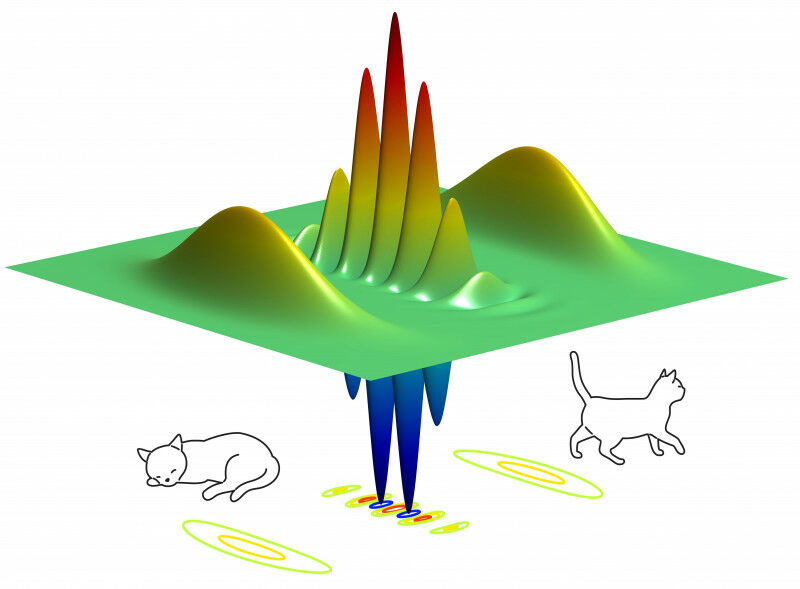
Credit: Vincenzo Savona (EPFL) Drawing from Schrödinger's cat thought experiment, scientists at EPFL have built a "critical cat code" qubit that uses bosons to store and process information in a way that is more reliable and resistant to errors than previous qubit designs. Quantum computing uses the principles of quantum mechanics to encode and elaborate data, meaning that it could one day solve computational problems that are intractable with current computers. While the latter work with bits, which represent either a 0 or a 1, quantum computers use quantum bits, or qubits - the fundamental units of quantum information. "With applications ranging from drug discovery to optimization and simulations of complex biological systems and materials, quantum computing has the potential to reshape vast areas of science, industry, and society," says Professor Vincenzo Savona, director of the Center for Quantum Science and Engineering at EPFL. Unlike classical bits, qubits can exist in a "superposition" of both 0 and 1 states at the same time. This allows quantum computers to explore multiple solutions simultaneously, which could make them significantly faster in certain computational tasks. However, quantum systems are delicate and susceptible to errors caused by interactions with their environment.
TO READ THIS ARTICLE, CREATE YOUR ACCOUNT
And extend your reading, free of charge and with no commitment.