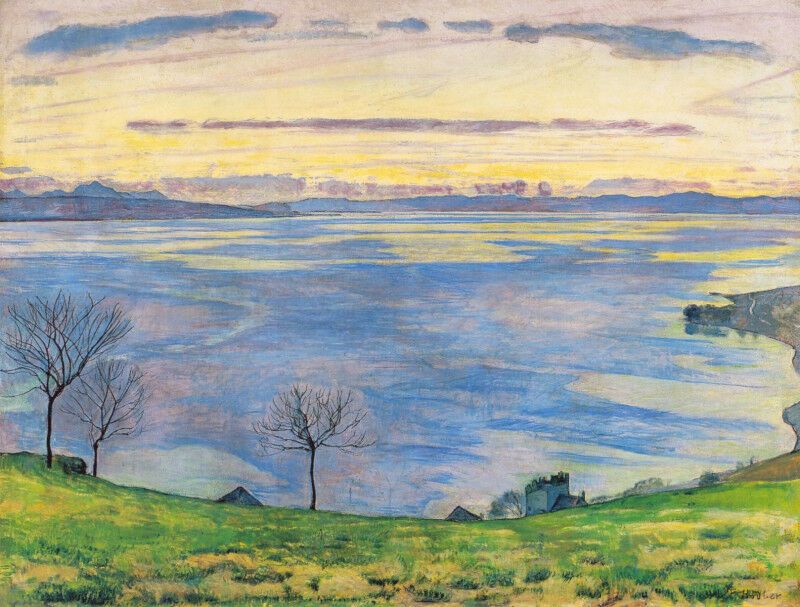
 Painting from Ferdinand Hodler, ’Lake Geneva on the evening in Chexbres’, 1895
Painting from Ferdinand Hodler, 'Lake Geneva on the evening in Chexbres', 1895 © Ferdinand Hodler - An EPFL researcher has, for the first time, documented slicks - those visually arresting, moving patches of smooth water - and explained what is happening beneath the surface. Natural slicks are a mysterious, intriguing phenomenon for anyone who enjoys looking out over Lake Geneva, including passers-by, commuters - and now local researchers. "If you search for information about them online, you won't find anything much," says Andrew Barry, head of the Ecological Engineering Laboratory (ECOL) at EPFL's School of Architecture, Civil and Environmental Engineering (ENAC). Mehrshad Foroughan, a PhD candidate at ECOL, was curious to learn more about natural slicks and ended up devoting his thesis to the topic. Some of his findings were recently published in Geophysical Research Letters and represent the first documented study of what slicks can reveal about lake hydrodynamics. Swiss painter Ferdinand Hodler skillfully captured the delicate way light plays off the lake's smooth surfaces as well as their hallmark texture. "Natural slicks and the materials constituting them play an important role in the transfer of energy between the water and the air, and thus the energy content of the lake," says Foroughan.
TO READ THIS ARTICLE, CREATE YOUR ACCOUNT
And extend your reading, free of charge and with no commitment.
Your Benefits
- Access to all content
- Receive newsmails for news and jobs
- Post ads