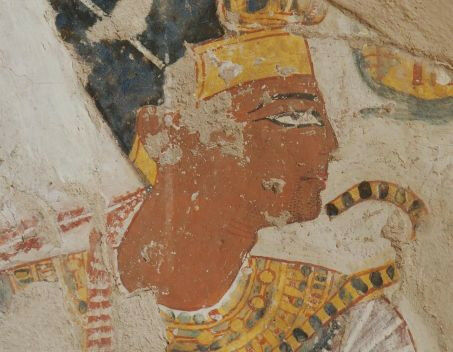
 Portrait of Ramses II from tomb of Nakhtamon (c. 1,200 BCE) . The headdress, necklace, and royal sceptre were touched up during the painting’s execution.
Portrait of Ramses II from tomb of Nakhtamon (c. BCE) . The headdress, necklace, and royal sceptre were touched up during the painting's execution. LAMS-MAFTO, CNRS Contrary to prior assumptions, ancient Egyptian painters did at times push the boundaries of convention. Artistic creations supposed to be copies of canonical images were in fact often adapted and reworked during their execution. This discovery was made using new, portable chemical imaging tools that leave the artworks intact. Within the scope of a vast research program undertaken in coordination with the Egyptian Ministry of Antiquities and the University of Liège, an international team-including scientists from the CNRS, Sorbonne University, and Université Grenoble Alpes-has revealed the artistic license exercised in two ancient Egyptian funerary paintings (dating to ~1,400 and ~1,200 BCE, respectively), as evident in newly discovered details invisible to the naked eye.
TO READ THIS ARTICLE, CREATE YOUR ACCOUNT
And extend your reading, free of charge and with no commitment.
Your Benefits
- Access to all content
- Receive newsmails for news and jobs
- Post ads