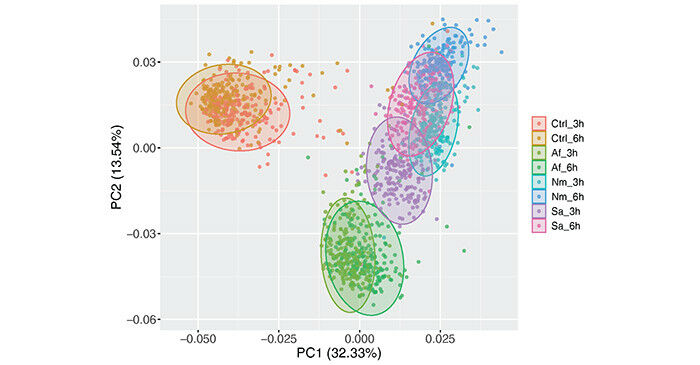
Analysis of RNA sequencing data of immune cells (monocytes) from 215 healthy individuals. Each dot represents the transcriptional response of an individual in unstimulated monocytes (Ctrl) and after exposure to different pathogens (fungus: Aspergillus fumigatus (Af); bacteria: Neisseria meningitidis (Nm) and Staphylococcus aureus (Sa), respectively) for three and six hours. The colours indicate the stimulus and the time. (Image: Sascha Schäuble / Leibniz-Institut für Naturstoff-Forschung und Infektionsbiologie (Leibniz-HKI, Jena))
Analysis of RNA sequencing data of immune cells (monocytes) from 215 healthy individuals. Each dot represents the transcriptional response of an individual in unstimulated monocytes (Ctrl) and after exposure to different pathogens (fungus: Aspergillus fumigatus (Af); bacteria: Neisseria meningitidis (Nm) and Staphylococcus aureus (Sa), respectively) for three and six hours. The colours indicate the stimulus and the time. (Image: Sascha Schäuble / Leibniz-Institut für Naturstoff-Forschung und Infektionsbiologie (Leibniz-HKI, Jena)) How do our genes determine the immune response to pathogens? This depends on small differences in the genome. The situation is complex, as a new study shows. Not everyone reacts to infectious agents in the same way: some fall ill very severely, others only slightly, and still others possibly not at all. There are many different reasons for this variability.
TO READ THIS ARTICLE, CREATE YOUR ACCOUNT
And extend your reading, free of charge and with no commitment.