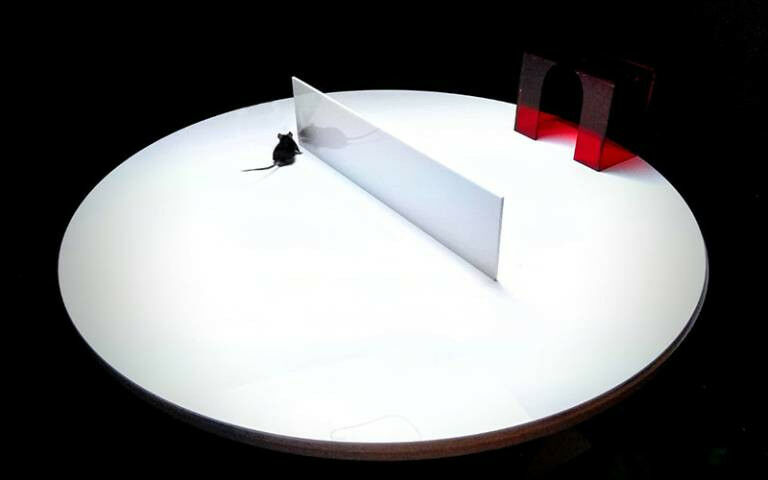
Mouse exploring its environment - Research mice at UCL (Credit: David Bishop, UCL)
Mouse exploring its environment - Research mice at UCL (Credit: David Bishop, UCL) Neuroscientists at UCL have uncovered how exploratory actions enable animals to learn their spatial environment more efficiently. Their findings could help build better AI agents that can learn faster and require less experience. Unit at UCL found the instinctual exploratory runs that animals carry out are not random. These purposeful actions allow mice to learn a map of the world efficiently. The study, published today in Neuron , describes how neuroscientists tested their hypothesis that the specific exploratory actions that animals undertake, such as darting quickly towards objects, are important in helping them learn how to navigate their environment. Professor Tiago Branco, Group Leader at the Sainsbury Wellcome Centre at UCL and corresponding author on the paper, said: "There are a lot of theories in psychology about how performing certain actions facilitates learning. In this study, we tested whether simply observing obstacles in an environment was enough to learn about them, or if purposeful, sensory-guided actions help animals build a cognitive map of the world." In previous work, scientists at UCL observed a correlation between how well animals learn to go around an obstacle and the number of times they had run to the object.
TO READ THIS ARTICLE, CREATE YOUR ACCOUNT
And extend your reading, free of charge and with no commitment.