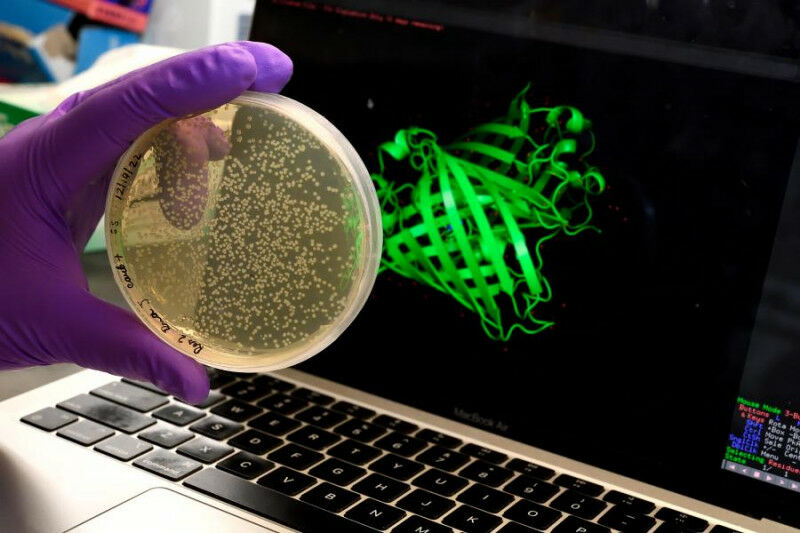
A purple-gloved hand holds a cell culture dish containing small white particles in a light yellow suspension in front of a laptop computer screen showing a folded protein in bright green
A purple-gloved hand holds a cell culture dish containing small white particles in a light yellow suspension in front of a laptop computer screen showing a folded protein in bright green - Surprising protein behavior could improve our understanding of aging - E. coli proteins lacking the ability to reassemble themselves could one day help scientists rethink studies of the human brain. Researchers have discovered a surprising anomaly in the behavior of how proteins form, upending long-held assumptions about the way cells produce these crucial molecules and potentially leading to a better understanding of aging and neurodegenerative diseases in humans. Contradicting conventional wisdom that proteins can reassemble themselves, Johns Hopkins University biochemists found a significant number of the proteins in E. coli could not, even when the team tried to spark the repairs in the lab with helper proteins called "chaperones." The finding was stunning, said senior author Stephen Fried , an assistant professor in the Department of Chemistry in the Krieger School of Arts and Sciences who led the research published recently in Proceedings of the National Academy of Sciences. "If proteins misfold, we are taught that chaperones are supposed to be able to fix them. But some proteins are like Humpty Dumpties: Once they fall, all the cells' men and horses can't put them back together again." "The most surprising finding is that there are certain proteins even chaperones can't help," Fried said.
TO READ THIS ARTICLE, CREATE YOUR ACCOUNT
And extend your reading, free of charge and with no commitment.