The Optical Nanomotion Detection method in action (see text for caption))
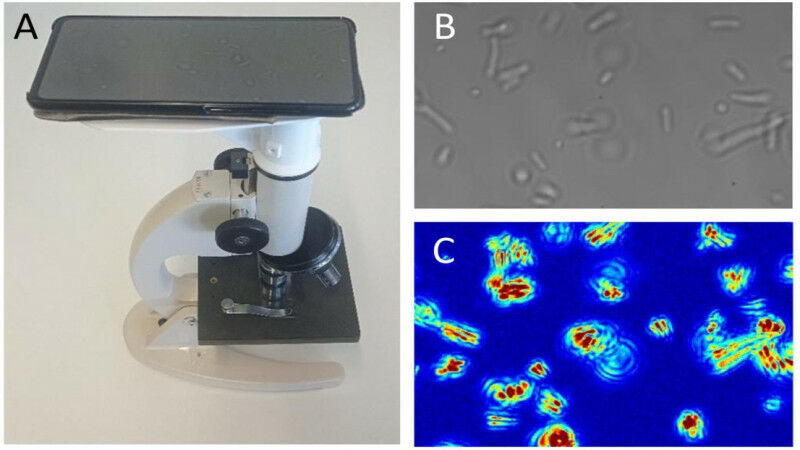
The Optical Nanomotion Detection method in action (see text for caption)) Researchers at EPFL and Vrije Universiteit Brussel have developed a novel and highly efficient method for rapid antibiotic susceptibility testing using optical microscopy. The technique, called Optical Nanomotion Detection, is extremely rapid, single-cell sensitive, label-free, and requires only a basic traditional optical microscope, equipped with a camera or a mobile phone. Figure caption: A. Setup to conduct Optical Nanomotion Detection based antibiotic susceptibility test: a low cost optical microscope and a mobile phone are enough. B. Optical image of E. coli bacteria. C. Same field of view as B in false colors that highlight bacterial displacements; Red: high amplitude motion; Blue: no displacement. Credits: Ines Villalba (EPFL) "We have developed a technique in our laboratories that allows us to obtain an antibiogram within 2-4 hours - instead of the current 24 hours for the most common germs and one month for tuberculosis," says Dr Sandor Kasas at EPFL. Professor Ronnie Willaert at Vrije Universiteit Brussel adds: "Our technique is not only faster but also simpler and much cheaper than all those existing now." Antibiotic resistance happens when bacteria develop the ability to defeat the drugs designed to kill them.
TO READ THIS ARTICLE, CREATE YOUR ACCOUNT
And extend your reading, free of charge and with no commitment.