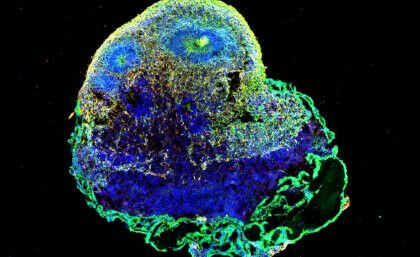
A brain organoid as seen under a microscope. Image: Dr Hannah Leeson, AIBN.
A brain organoid as seen under a microscope. Image: Dr Hannah Leeson, AIBN. University of Queensland researchers have found a way to reverse a cellular process triggered by COVID-19 that contributes to premature ageing of the brain. Dr Julio Aguado and a team from UQ's Australian Institute for Bioengineering and Nanotechnology (AIBN) used synthetic brain organoid models, grown in a laboratory from human stem cells, to study the effect of different SARS-COV-2 variants on brain tissue. "We found COVID-19 accelerates the presence of 'zombie' or senescent cells, which accumulate naturally and gradually in the brain as we get older," Dr Aguado said. "Senescent cells are known to drive tissue inflammation and degeneration, leaving patients exposed to cognitive impairments like brain fog and memory loss." Dr Aguado said confirmation that COVID-19 was a catalyst for this premature ageing prompted an attempt to reset the biological brain clock. "We used the brain organoids to screen a range of therapeutics, looking for any capable of removing those senescent cells," he said.
TO READ THIS ARTICLE, CREATE YOUR ACCOUNT
And extend your reading, free of charge and with no commitment.