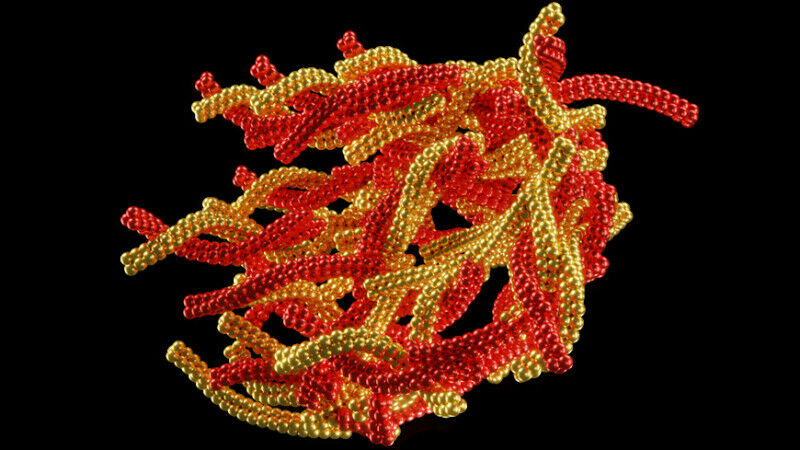
In Alzheimer’s disease, protein fibrils in the brain form plaques. The accumulation of such tangles leads to the death of nerve cells and a loss of cognitive performance. Illustration: Empa / Communications Biology
In Alzheimer's disease, protein fibrils in the brain form plaques. The accumulation of such tangles leads to the death of nerve cells and a loss of cognitive performance. Illustration: Empa / Communications Biology During the course of Alzheimer's disease, protein fibrils appear in the spinal fluid of affected individuals. researchers, together with the Department of Neurology at the Cantonal Hospital in St. Gallen, have now visualized the wide spectrum of protein aggregates from oligomers, protofibrils to fibrils in the spinal fluid. The conclusion: Ultra-long protein fibrils are a signature of severe Alzheimer's disease. The study, recently published in Communications Biology , sheds light into the delicate role of protein aggregation in the development of Alzheimer's disease and is expected to improve early detection of dementia. The early detection and treatment of dementia such as Alzheimer's is still one of the great challenges of modern medicine.
TO READ THIS ARTICLE, CREATE YOUR ACCOUNT
And extend your reading, free of charge and with no commitment.