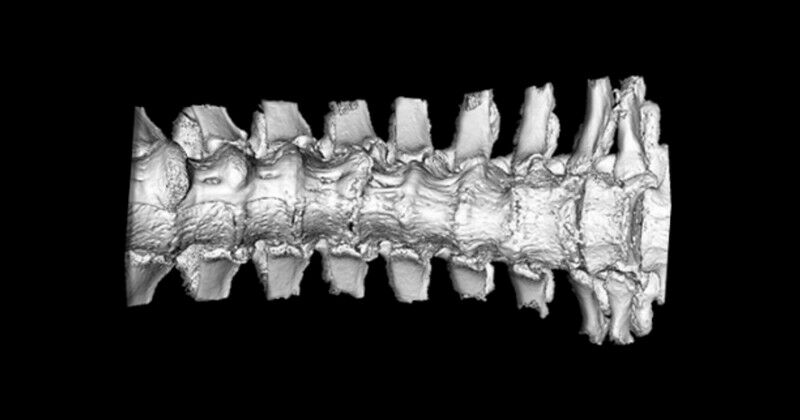
Image of a spine (Séguin Lab)
Image of a spine (Séguin Lab) Team examined association between pain and DISH, a disease that causes calcification of the spine After hearing first-hand from patients about how the disease impacted their lives, a team of researchers and graduate students at Western were inspired to investigate the symptoms associated with an understudied spine disease called diffuse idiopathic skeletal hyperostosis (DISH). Prior studies suggest DISH affects up to a third of men over the age of 50. This non-inflammatory type of arthritis is characterized by the progressive calcification of spinal tissues that eventually leads to the fusion of the vertebrae within the spine. However, whether this calcification causes pain, especially in the early stages of the disease, isn't well understood or well documented. The study was led by Schulich Medicine & Dentistry professor Cheryle Séguin. (Schulich Medicine & Dentistry Communications photo) "We were hearing from patients that they were increasingly frustrated by descriptions of the disease as asymptomatic, when that wasn't at all their lived experience," said Cheryle Séguin, Schulich School of Medicine & Dentistry professor and lead author on the study. "We wanted to see, using the tools in our lab, if we could better understand how pain and physical disability are associated with the progressive spine calcification that happens in this disease." Using a mouse model, the team demonstrated in a study recently published in the journal Arthritis Research & Therapy that even in the early stages of the disease, there was evidence of back stiffness and pain.
TO READ THIS ARTICLE, CREATE YOUR ACCOUNT
And extend your reading, free of charge and with no commitment.