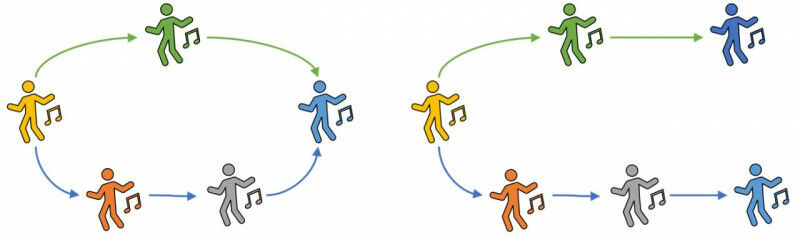
Different interaction structures lead to variations in synchronicity, not just among people but in nature, biology and systems. Image: Associate Joseph Lizier.
Different interaction structures lead to variations in synchronicity, not just among people but in nature, biology and systems. Image: Associate Joseph Lizier. Synchronicity is all around us, but it is poorly understood. Computer scientists have now developed new tools to understand how human and natural networks fall in and out of sync. Computer scientists and mathematicians working in complex systems at the University of Sydney and the Max Planck Institute for Mathematics in the Sciences in Germany have developed new methods to describe what many of us take for granted - how easy, or hard, it can be to fall in and out of sync. Synchronised phenomena are all around us, whether it is human clapping and dancing, or the way fireflies flash, or how our neurons and heart cells interact. However, it is something not fully understood in engineering and science.
TO READ THIS ARTICLE, CREATE YOUR ACCOUNT
And extend your reading, free of charge and with no commitment.