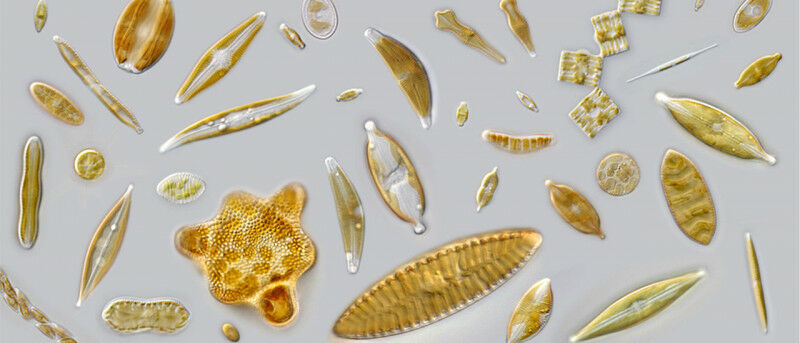
The versatile morphology of living diatoms. (Image: Oliver Skibbe)
The versatile morphology of living diatoms. (Image: Oliver Skibbe) An international research team with participation from Würzburg has discovered how algae compensate for nutrient deficiencies. Their discovery could help counteract the negative effects of climate change. One of the building blocks of ocean life can adapt to cope with the effects of climate change, according to new research led by the University of East Anglia (UEA). The discovery holds promises for biotechnology developments that could counter the negative effects of changing environmental conditions, such as ocean warming and even the reduction in the productivity of crops. Corresponding authors of the study, now published in the journal Nature Microbiology, are Thomas Mock, Professor of Marine Microbiology in the School of Environmental Sciences at UEA, and his former PhD candidate Dr. Jan Strauss. At Julius-Maximilians-Universität Würzburg (JMU), Professor Georg Nagel and Dr. Shiqiang Gao from the Department of Neurophysiology at the Institute of Physiology were involved.
TO READ THIS ARTICLE, CREATE YOUR ACCOUNT
And extend your reading, free of charge and with no commitment.