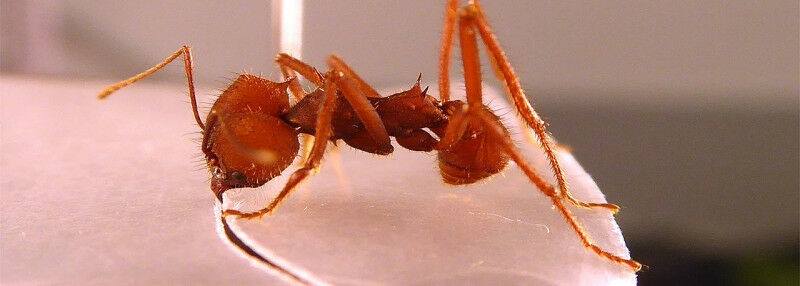
A typical behaviour: When the leafcutter ant Atta sexdens cuts pieces of leaves, it holds onto the leaf edge with its hind legs to determine the size of the cut. (Image: Daniela Römer, Uni Würzburg)
A typical behaviour: When the leafcutter ant Atta sexdens cuts pieces of leaves, it holds onto the leaf edge with its hind legs to determine the size of the cut. (Image: Daniela Römer, Uni Würzburg) How do leafcutter ants measure the size of the leaf pieces they cut off? A study by the University of Würzburg now provides answers. Up to three million specimens, translated into human terms about twice as many inhabitants as Munich - that's how large a single colony of leafcutter ants can become. To feed so many creatures at the same time, the animals have developed a sophisticated system: In their underground nests, they grow fungi, which they distribute to the colony as food. The nutrient medium for the fungus growth is a mixture of chopped leaf pieces that the animals obtain from surrounding trees and shrubs. A study by the Julius-Maximilians-University of Würzburg has now investigated how leafcutter ants measure the correct size of these leaf pieces. "Until now, it was assumed that the length of an animal alone determined this - that smaller ants simply cut smaller pieces and larger ones cut larger pieces," explains Dr. Daniela Römer, a biologist at the Department of Zoology II at the University of Würzburg.
TO READ THIS ARTICLE, CREATE YOUR ACCOUNT
And extend your reading, free of charge and with no commitment.