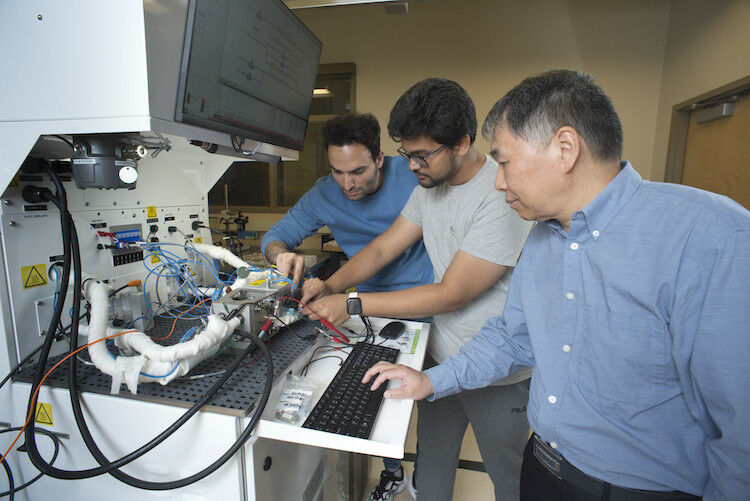
Researchers partner with industry to advance innovation in decarbonization By Faculty of Engineering Faculty of Engineering In the quest to reach zero emissions by 2050, Waterloo engineering researcher Dr. Xianguo Li and Dr. Samaneh Shahgaldi from Université du Québec à Trois-Rivières (UQTR) are working with industry partners to develop more efficient, durable, cost-effective fuel cells. Hydrogen is a promising solution for decarbonizing various sectors, transportation in particular, but hydrogen-based fuel systems rely heavily on the technology of metallic bipolar plates - a technology the Waterloo and UQTR researchers, along with mining company, Niobay Metals, are refining with support from Mitacs , a not-for-profit organization that empowers Canadian innovation by making investing in new knowledge easier through access to top researchers, flexible project plans, and co-investments in talent. "One sector that is really difficult to decarbonize is transport," said Li, leader of the University of Waterloo's Fuel Cell and Green Energy Laboratory and editor-in-chief for the International Journal of Green Energy. "So, we are investigating metallic materials that have high mechanical strength, high thermal conductivity, and can be made much, much thinner than traditional materials." The vital ingredient needed to make these materials is niobium, a naturally occurring grey crystalline metal that is classified as a technology-critical element with stability that makes it useful for rocket and jet engines.
TO READ THIS ARTICLE, CREATE YOUR ACCOUNT
And extend your reading, free of charge and with no commitment.