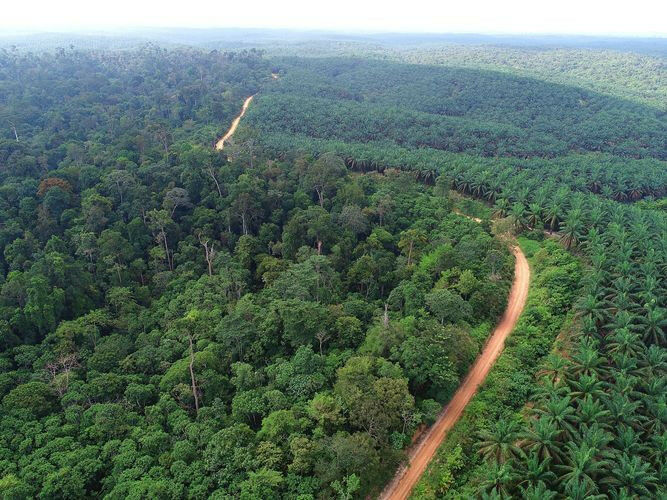
Rain forest (left) and oil palm plantation (right), Photo: Ananggadipa Raswanto
Rain forest ( left ) and oil palm plantation ( right ) , Photo: Ananggadipa Raswanto - The conversion of rainforest into plantations erodes and restructures food webs and fundamentally changes the way these ecosystems function, according to a new study published in Nature. The findings provide the first insights into the processing of energy across soil and canopy animal communities in mega-biodiverse tropical ecosystems. Every day, new areas of rainforests are converted into plantations, drastically changing tropical biodiversity and the way the ecosystem functions. Yet, the current understanding of the consequences is fragmentary: previous studies tended to examine either biodiversity or the ecosystem. An international research team led by the universities of Göttingen in Germany and Bogor in Indonesia in collaboration with the German Centre for Integrative Biodiversity Research (iDiv) and Leipzig University brings these threads together in this study. They analysed organisms ranging from microscopic mites and earthworms in the soil, to beetles and birds in tree canopies, comparing tropical rainforest with rubber and oil palm plantations in Sumatra, Indonesia. The researchers set out to study both biodiversity - plants, insects, vertebrates - and changes in how food webs function - biomass, trophic structure, energy fluxes.
TO READ THIS ARTICLE, CREATE YOUR ACCOUNT
And extend your reading, free of charge and with no commitment.