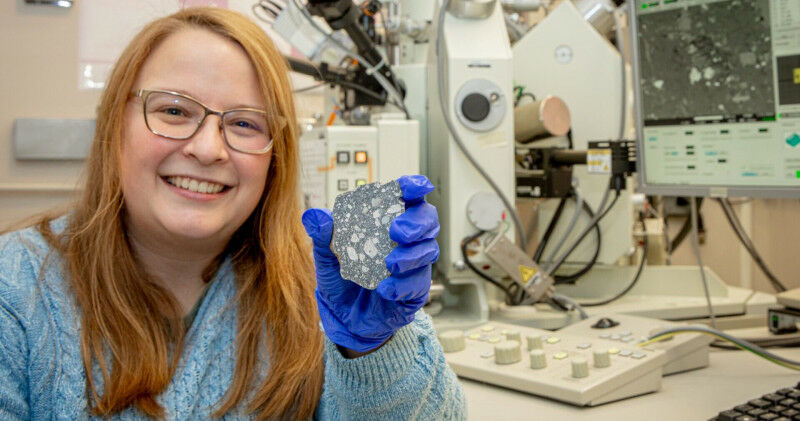
Western postdoctoral fellow Tara Hayden with a lunar meteorite, which was not a part of the study, in the Earth and Planetary Materials Analysis Laboratory. (Photo by Christopher Kindratsky)
Western postdoctoral fellow Tara Hayden with a lunar meteorite, which was not a part of the study, in the Earth and Planetary Materials Analysis Laboratory. (Photo by Christopher Kindratsky) - New research from Western University shows the early lunar crust, which makes up the surface of the Moon, was considerably enriched in water more than 4 billion years ago, counter to previously held understanding. The discovery is outlined in a study published today in the journal Nature Astronomy . Working with a meteorite she classified as one that came from the Moon while a graduate student at The Open University (U.K. Tara Hayden identified, for the first time, the mineral apatite (the most common phosphate) in a sample of early lunar crust. The lunar meteorite sample Tara Hayden investigated and successfully discovered the water-bearing mineral apatite. The research offers exciting new evidence that the Moon's early crust contained more water than was originally thought, opening new doors into the study of lunar history.
TO READ THIS ARTICLE, CREATE YOUR ACCOUNT
And extend your reading, free of charge and with no commitment.