Forests can overheat in extreme temperatures - and reach temperatures that could be fatal. Alice Gauthey and a team from WSL and EPFL had an opportunity to investigate this phenomenon in France in the summer of 2023: in Holm oak forest plots, the thermometer climbed to almost 50 degrees Celsius, the highest temperatures ever measured there. They wanted to follow how the canopy temperature varies during the day and over the summer.
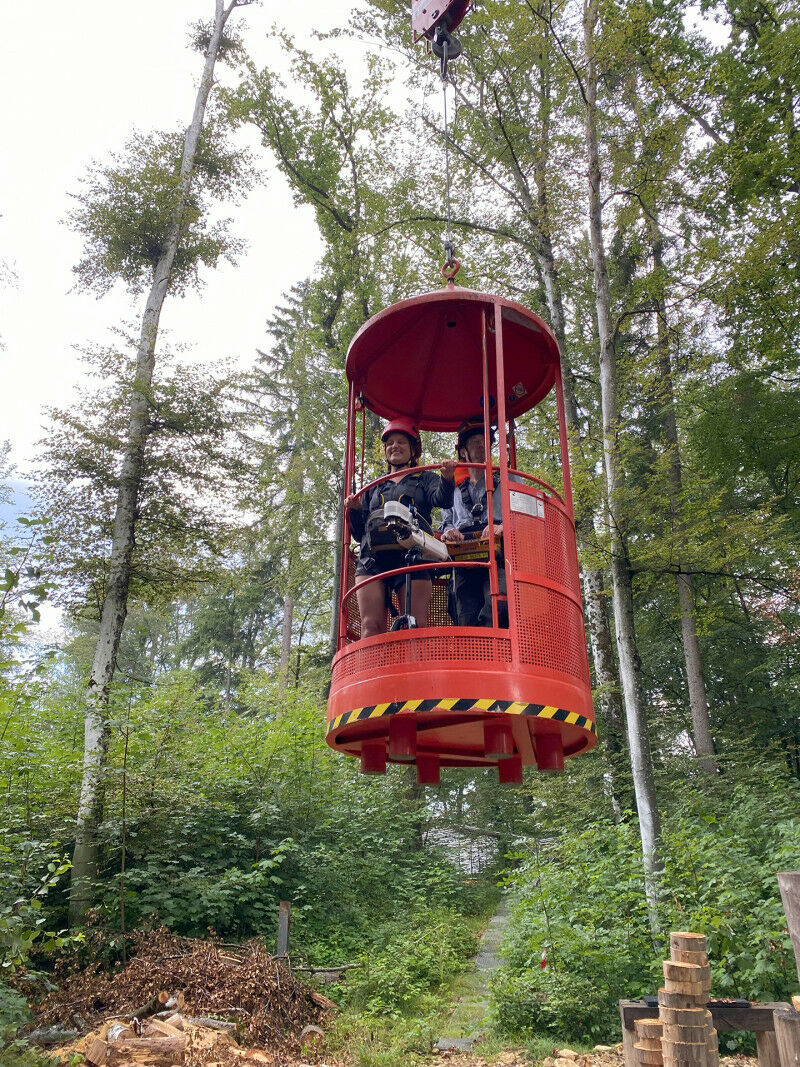
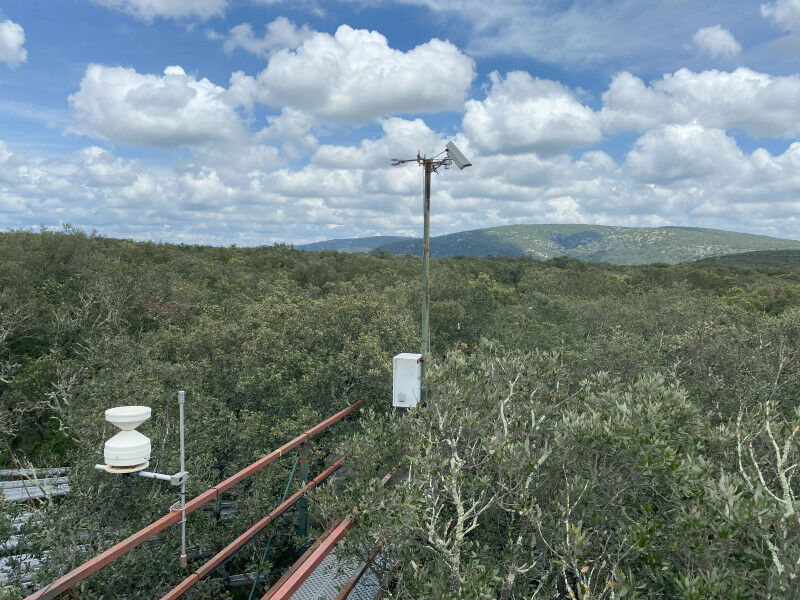
The team used drones with infrared thermal imaging cameras mounted on them. These flew over forests in Switzerland, France, and Spain on hot days and recorded the temperature of the uppermost leaf layer. The researchers also measured photosynthesis and water loss in the leaves on branches in the treetops. Because the sessile oaks (Quercus petraea) in the Basel Jura are a good 30 meters high, the researchers used a crane to reach the top of canopies. In France, scaffolding were used to measure the holm oaks (Quercus ilex). In Spain, no aids were needed: the Kermes oaks (Quercus coccifera) only grow to a natural height of around 1.5 meters or less.
The results show that the oaks can withstand astonishing temperatures. "The leaves at the top of the canopy reached temperatures of up to 50 degrees Celsius in August, which is pretty incredible," says study leader Charlotte Grossiord, a forest ecologist at WSL and EPFL. This was at an air temperature of "only" around 40 to 42 degrees.
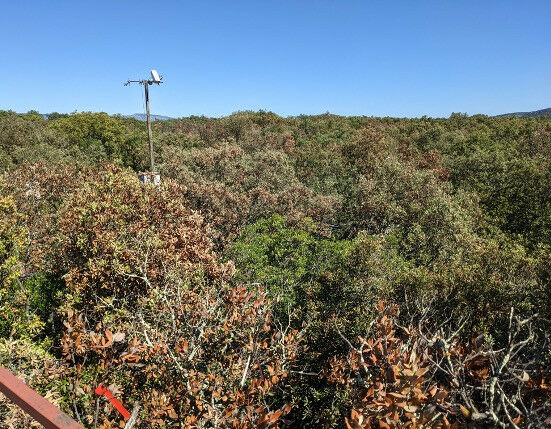
The fact that they rarely reached this level is probably due to another process: The leaves always lost a little water, the measurements show. Trees indeed close the pores on the underside of their leaves at some point during hot weather, through which they absorb and release gases. But a little water evaporates passively through the leaf surface. Both processes, the active and the passive, play a role, says Grossiord. They cooled the leaves just enough. Only the most exposed leaves at the top of the canopy turned brown and dry.
The heat tolerance of those oaks is much higher than that of some conifers previously assessed in Switzerland, says Grossiord. However, their canopy structure with thin needles and sparse branches prevents such high temperatures inside the needles, as previous experiments by the team in the Pfynwald forest in Valais have shown.
Thermal images of the treetops at the hottest time of day in Spain (top) and France (bottom). Yellow colors and yellow show the highest temperatures - in Spain, this is the ground, and in France, the treetops. (Photos: Alice Gauthey)
Many techniques are already in use in agriculture to prevent plants from overheating, says Grossiord. For example, infrared cameras tracking the surface temperature of fields have been used to determine the irrigation needs in crops. In the forestry sector, remote sensing technologies are still new. "Our study shows that we can also use drones or satellites, for example, for detecting early heat stress signals in forests."
Overflight of the treetops of the sessile oaks in Hölstein (BL) with the crane (left) or the drone (right). Alice Gauthey and Alex Tunas)