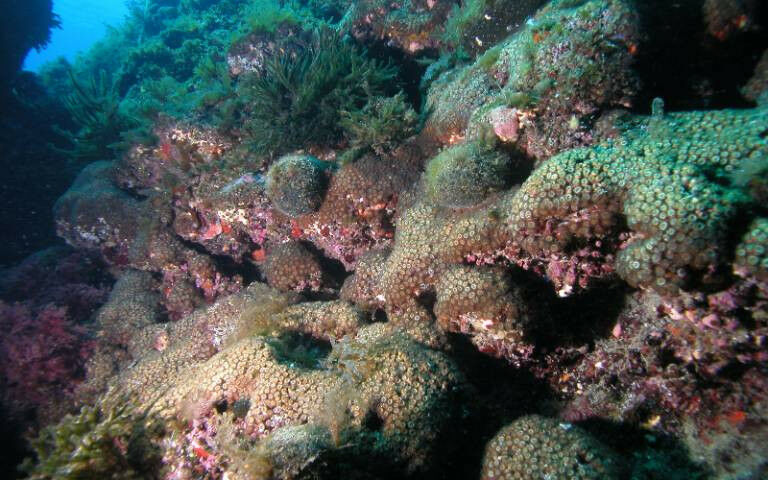
A reef of corals underwater.The coral species, Cladocora caespitosa on the seafloor of Illa Grossa Bay, off the Columbretes Islands in the Mediterranean Sea. Credit: Diego K. Kersting
A reef of corals underwater.The coral species, Cladocora caespitosa on the seafloor of Illa Grossa Bay, off the Columbretes Islands in the Mediterranean Sea. Credit: Diego K. Kersting For the first time, pollutants from burning fossil fuels have been found embedded in corals, offering scientists a potential new tool to track the history of pollution, finds a new study led by UCL researchers. The study, published in the journal Science of the Total Environment , identified carbon particles emitted by burning fossil fuels embedded in the corals of Illa Grossa Bay, off the Columbretes Islands in the Mediterranean Sea. Finding this type of pollution - known as fly-ash or spheroidal carbonaceous particles (SCPs) - contaminating natural deposits is seen as an indicator of the presence of human influence on the environment, and an historical marker of the beginning of the proposed Anthropocene epoch. Corals are a commonly used natural archive for paleoclimate studies because of their measurable growth rates. Akin to tree rings, their long life and slow and regular growth can provide scientists with annual, monthly or even weekly, environmental data going back years. Up to now, they've largely been used to gauge past climatic conditions like water temperatures and chemistries, but this is the first time that pollutant particles - other than microplastics - have been recovered from corals.
TO READ THIS ARTICLE, CREATE YOUR ACCOUNT
And extend your reading, free of charge and with no commitment.