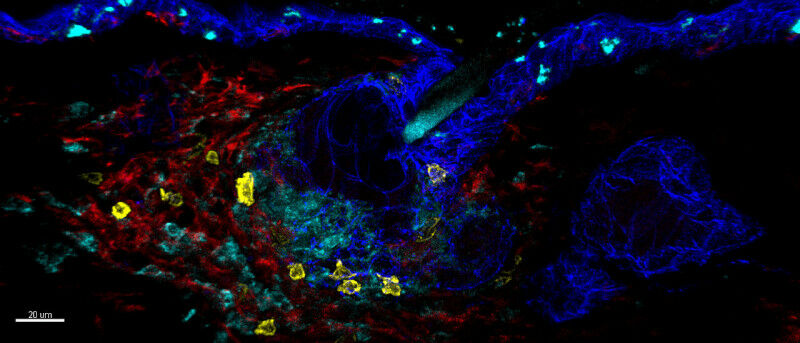
NK cells remain in the skin after overcoming an infection: Keratin-14 (blue) highlights the course of the outermost skin layers (epidermis). NKp46+ NK cells (yellow) inhabit the subcutaneous tissue (dermis) and cluster around a hair follicle (recognizable as an indentation of the epidermis) (Image: Tommaso Torcellan / JMU)
NK cells remain in the skin after overcoming an infection: Keratin-14 ( blue ) highlights the course of the outermost skin layers (epidermis). NKp46+ NK cells ( yellow ) inhabit the subcutaneous tissue (dermis) and cluster around a hair follicle (recognizable as an indentation of the epidermis) (Image: Tommaso Torcellan / JMU) - Natural killer cells of the innate immune system can permanently remain in infected tissue and thus contribute to immunological memory. Researchers at the University of Würzburg have now discovered this. A team of the Max Planck Research Group for Systems Immunology led by Würzburg immunologist Georg Gasteiger has published surprising findings about cells of the innate immune system, the natural killer cells, in the journal Immunity: During local infections in the skin, these cells can migrate into the tissue and remain there long-term. In doing so, they contribute to the immunological memory. The fact that lymphocytes of the innate immune system possess these abilities was not known until now. Natural killer cells are part of the innate immune defense.
TO READ THIS ARTICLE, CREATE YOUR ACCOUNT
And extend your reading, free of charge and with no commitment.